
Pottery Wheel
A lump of clay, a spinning wheel, and a shape in the corner you have to hit
About Pottery Wheel
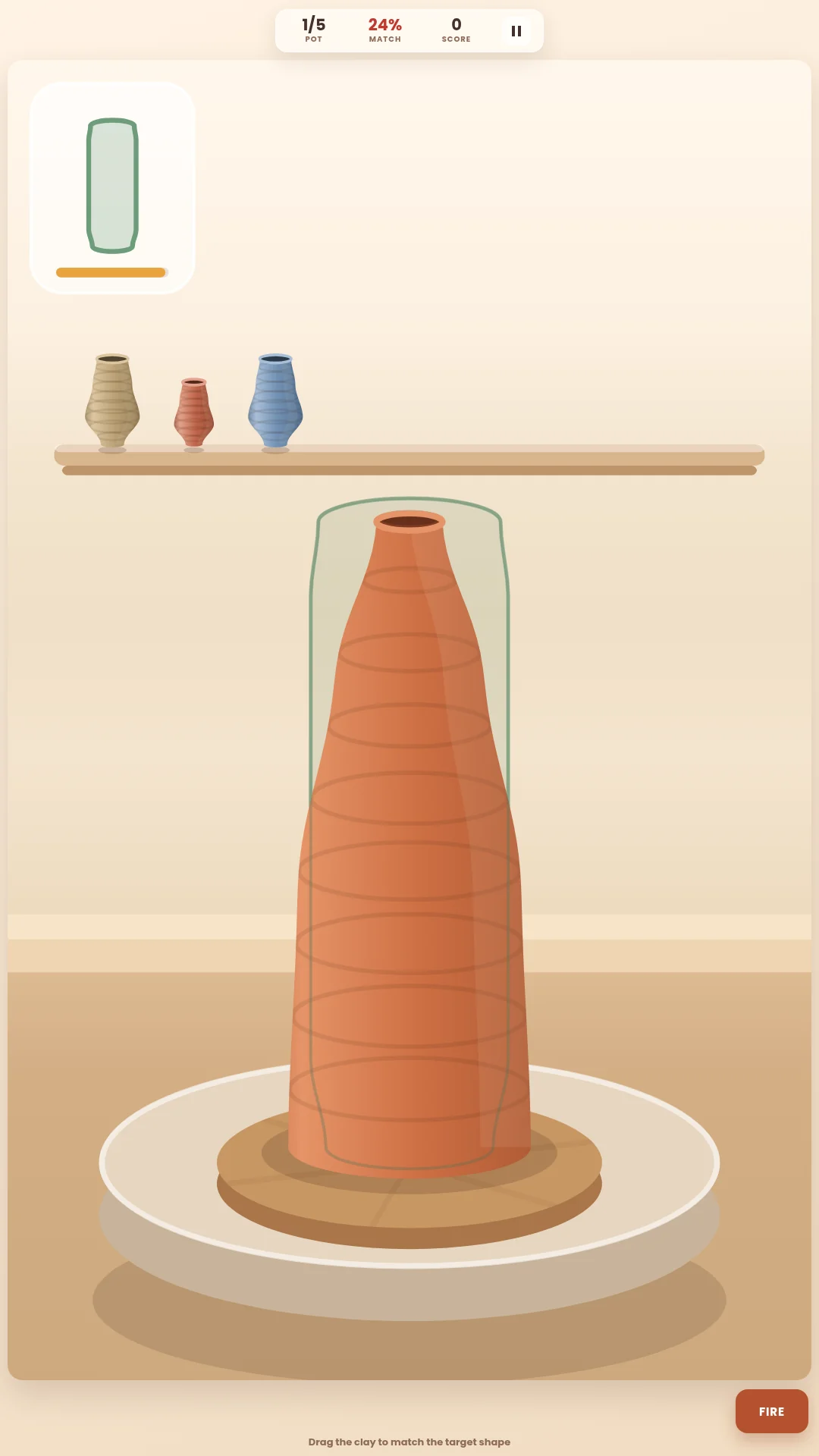
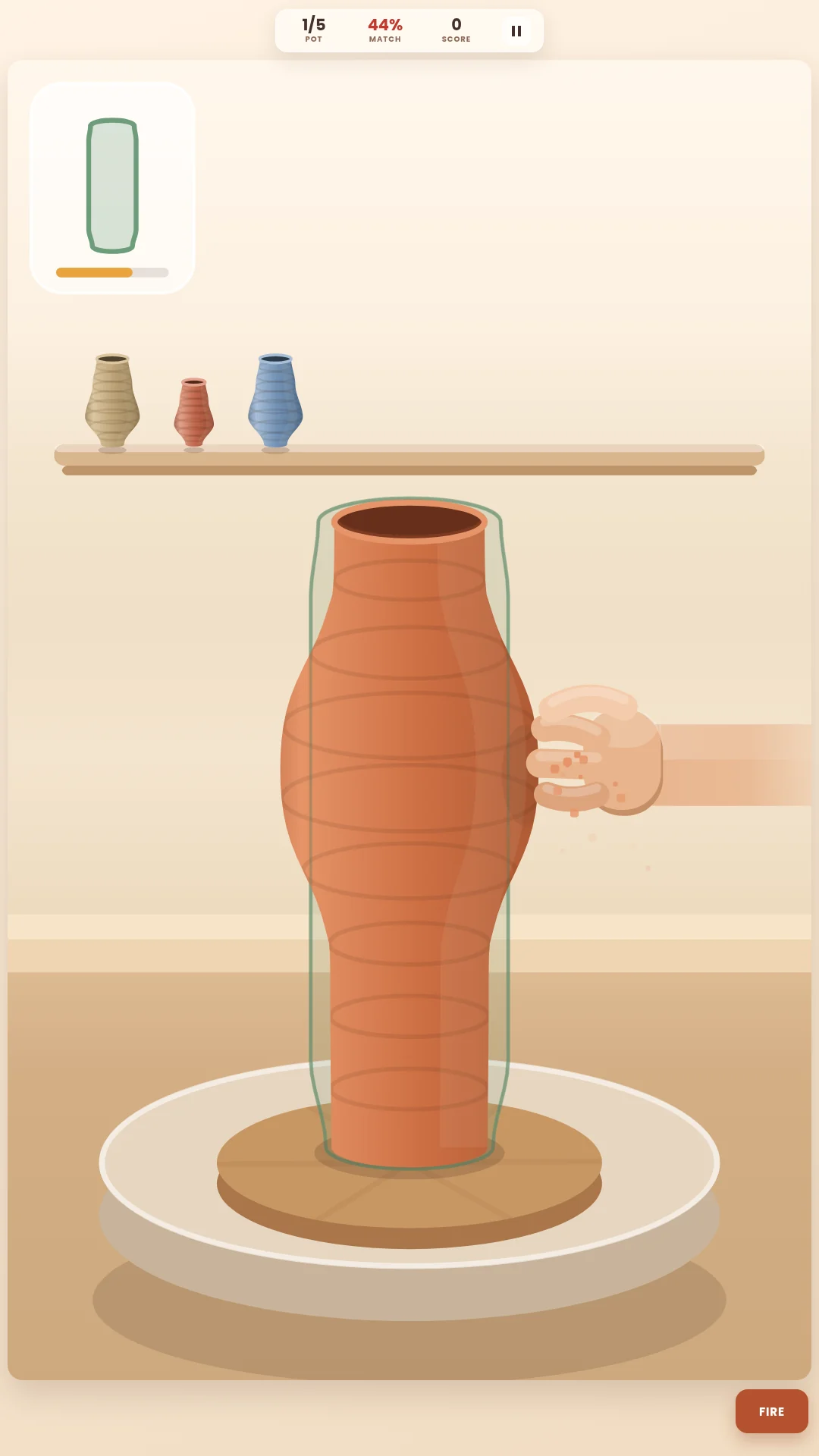
Five pots, one wheel, and a target silhouette pinned in the corner of the studio. The clay starts as a cone on the bat and turns whether you touch it or not. Drag against the wall and it moves to your finger — push in and it narrows there, pull out and it bellies. The target is also drawn faintly over the clay itself, so you are never guessing where the wall should sit; you are only trying to get it there before the timer on the card runs out.
The clay is conserved. There is exactly as much of it as the target needs, and the total never changes, so every millimetre you pull out at the shoulder is taken from somewhere else. Widening the belly thins the neck. Opening the rim pulls clay up out of the base. Nothing is added and nothing is thrown away, which is why a pot that is right at the waist and wrong at the foot is usually a pot that has had too much attention paid to the waist.
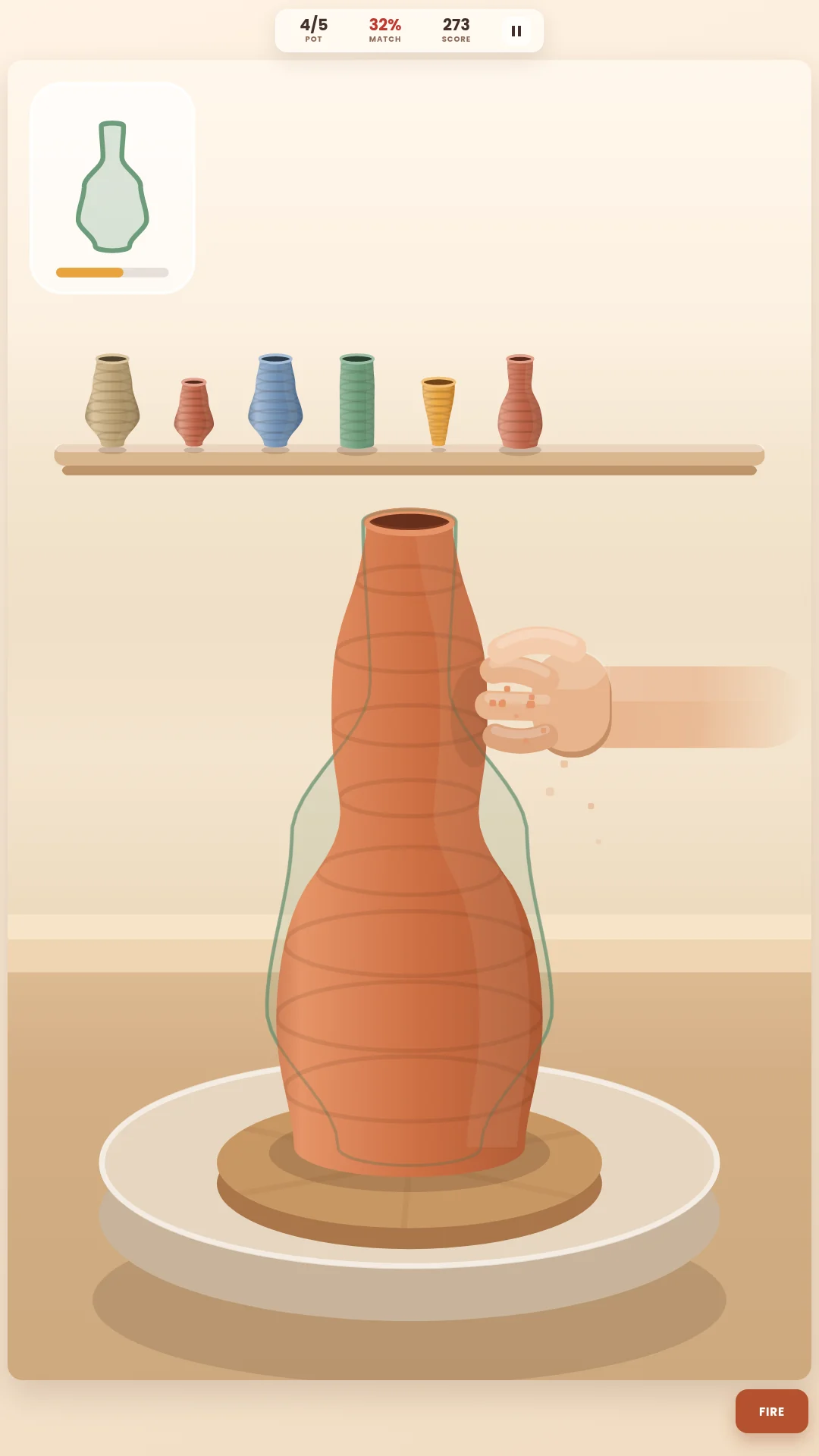
Wet clay also settles. Left alone for a moment the wall relaxes towards its neighbours, so a sharp step you cut into it softens on its own. That works for you on a bowl and against you on a bottle neck. Fire the pot when you are happy with it — the match is scored, the leftover time is worth up to eighteen points, and the glazed result goes onto the shelf behind you. Three hundred points across the five pots and the studio is yours.
What is different about this version
The clay is conserved rather than spent. Most shaping games let you add material wherever you press, which makes the target a checklist you tick off one band at a time. Here the total volume is fixed and every target has been built to use exactly that much, so the pot is always a trade: the only place a wider shoulder can come from is a thinner neck, a smaller foot or a lower rim. That turns a matching exercise into a budgeting one, and it is why the last two shapes — a narrow-necked bottle and an amphora — are hard even though you can see exactly where the wall is meant to be.
How to play Pottery Wheel
- Drag on the spinning clay — the wall follows your finger, in or out, at that height.
- The pale green outline over the clay is the target; work until the two agree.
- There is a fixed amount of clay: pulling out in one place takes it from another.
- MATCH in the HUD is live, so you can see whether a pass helped or hurt.
- Press FIRE (or Space) when it is close — the time you did not use is worth points.
- The pot is glazed, scored and set on the shelf, then the next target arrives.
- Finish all five pots with 300 points or more to win the studio.
Controls
| Desktop | Drag with the mouse to shape; arrow keys or WASD move the rib and push or pull; Space fires the pot; Escape or P pauses. |
|---|---|
| Phone or tablet | Drag a finger up and down the clay to shape it, and tap FIRE when the pot is ready. |
| Players | One player. Any other characters on screen are run by the game. |
Strategy
Work the extremes first. The widest and narrowest points of the target are where the clay has to travel furthest, and because the volume is fixed, setting them early drags the rest of the wall roughly into place for free. Fixing the belly of an amphora before you touch the neck means the neck is already halfway there; doing it the other way round undoes the neck.
Then stop scrubbing. The wall relaxes towards its neighbours every frame, so a section you have just cut sharply will drift for a second or two after you let go. Long passes from the rim down to the foot in one stroke leave a smoother, more even wall than a dozen short corrections in the same place, and they cost less of the clock.
Finally, read the MATCH number rather than the pot. It updates live, and a pass that looks better but reads lower has almost always stolen clay from a part of the profile you are not looking at. When the number stops climbing, fire — an extra ten seconds of fiddling is worth about six points of leftover-time bonus, and it is very easy to lose more than that.
Mistakes that cost you the game
- Perfecting one band. The clay it needs comes out of the rest of the pot, and the match falls while that one band looks great.
- Shaping the neck of a bottle before the body. The body has to take clay from somewhere, and it takes it from the neck you just finished.
- Holding the finger still against the wall. The wall reaches your finger in a fraction of a second; everything after that is wasted clock.
- Running the timer to zero. The pot fires anyway, and you throw away a bonus worth almost a fifth of a perfect pot.
Tips
- Set the widest point of the target first — the rest of the wall follows it.
- Use long strokes from rim to foot; short pokes fight the way the clay settles.
- Watch MATCH, not the silhouette. It tells you when a pass has cost you elsewhere.
- Fire as soon as the number stops climbing; the leftover time is worth up to 18 points.
- A bowl is the easiest target and a bottle the hardest — bank points early.
Questions about Pottery Wheel
Can I add more clay?
No. The amount is fixed for the whole pot, and every target is built to use exactly that much, so shaping is always a trade between one part of the wall and another.
Why does my shape keep softening?
Wet clay settles towards its neighbours, so sharp steps relax on their own. Cut slightly past what you want and let it come back.
What happens if the timer runs out?
The pot fires exactly as it is. You keep the match score but lose the leftover-time bonus, which is worth up to 18 points a pot.
How do I win?
Score 300 or more across the five pots. Below that the kiln closes and the run ends.
Does it cost anything?
No. Pottery Wheel is free to play, runs in your browser, and needs no download, install or account.
More games like this
-
 Claw CraneA candy-pink claw machine full of plush critters, and ten tokens to win them all
-
 Emoji DrawerSixty-three emoji, one blank square, and a percentage that updates while you draw
-
 Paint & HidePaint yourself to match the wall before the seeker walks past
-
 3072 MergeSlide a 4x4 grid, fuse matching tiles, and try to build the 3072