
Number Forge
Four ingots, one target, and every puzzle built backwards from a solution that exists
About Number Forge
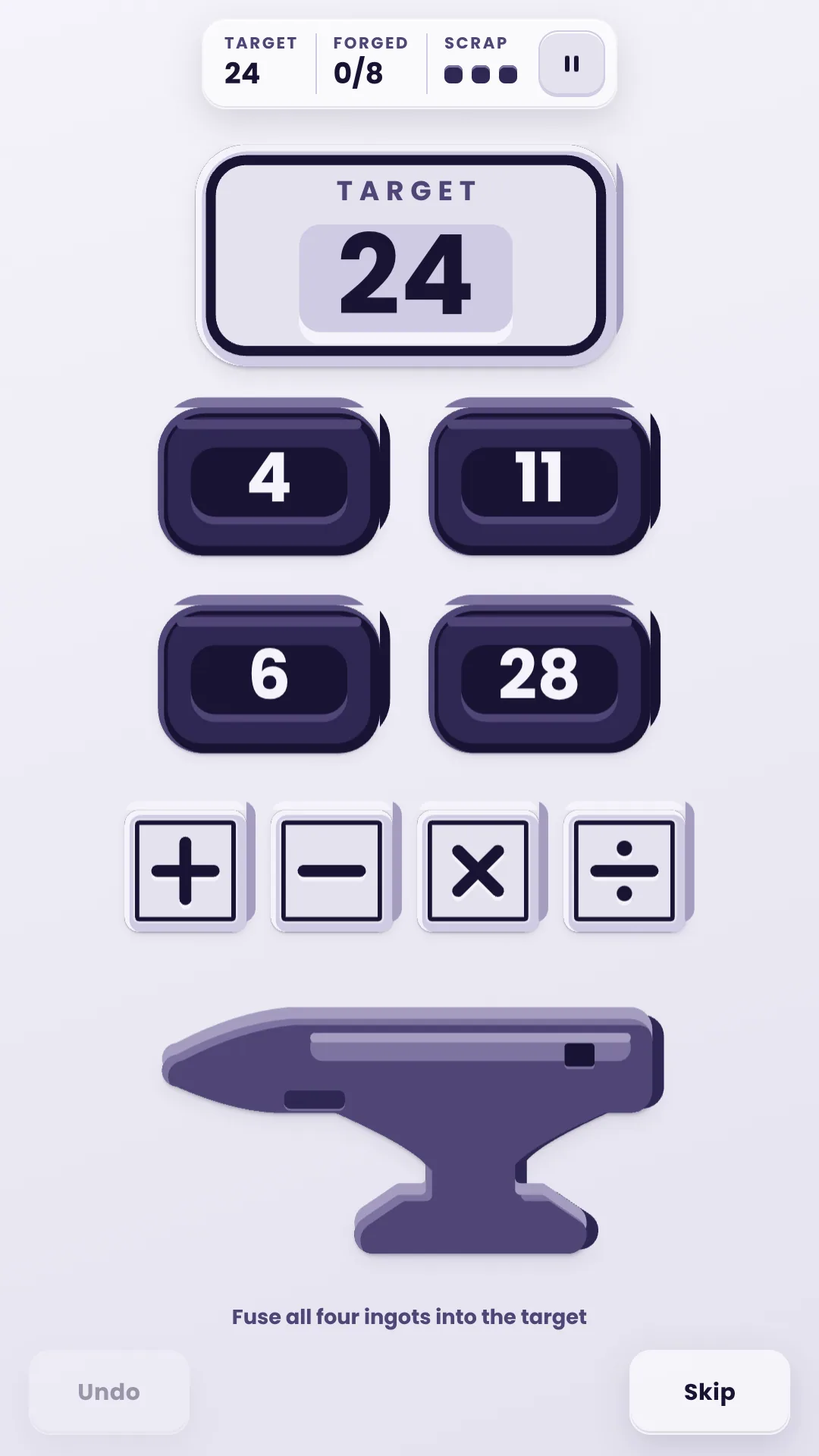
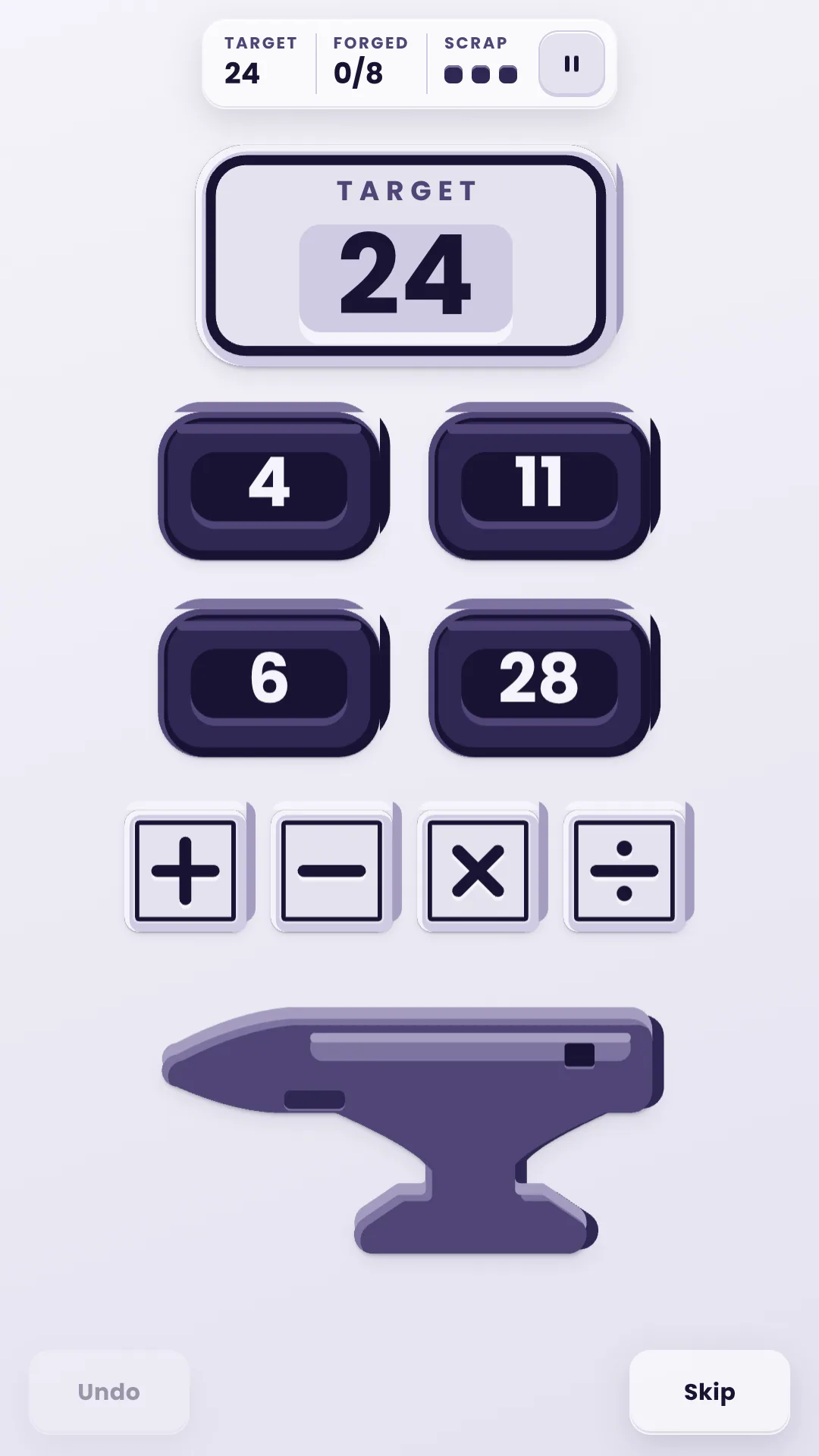
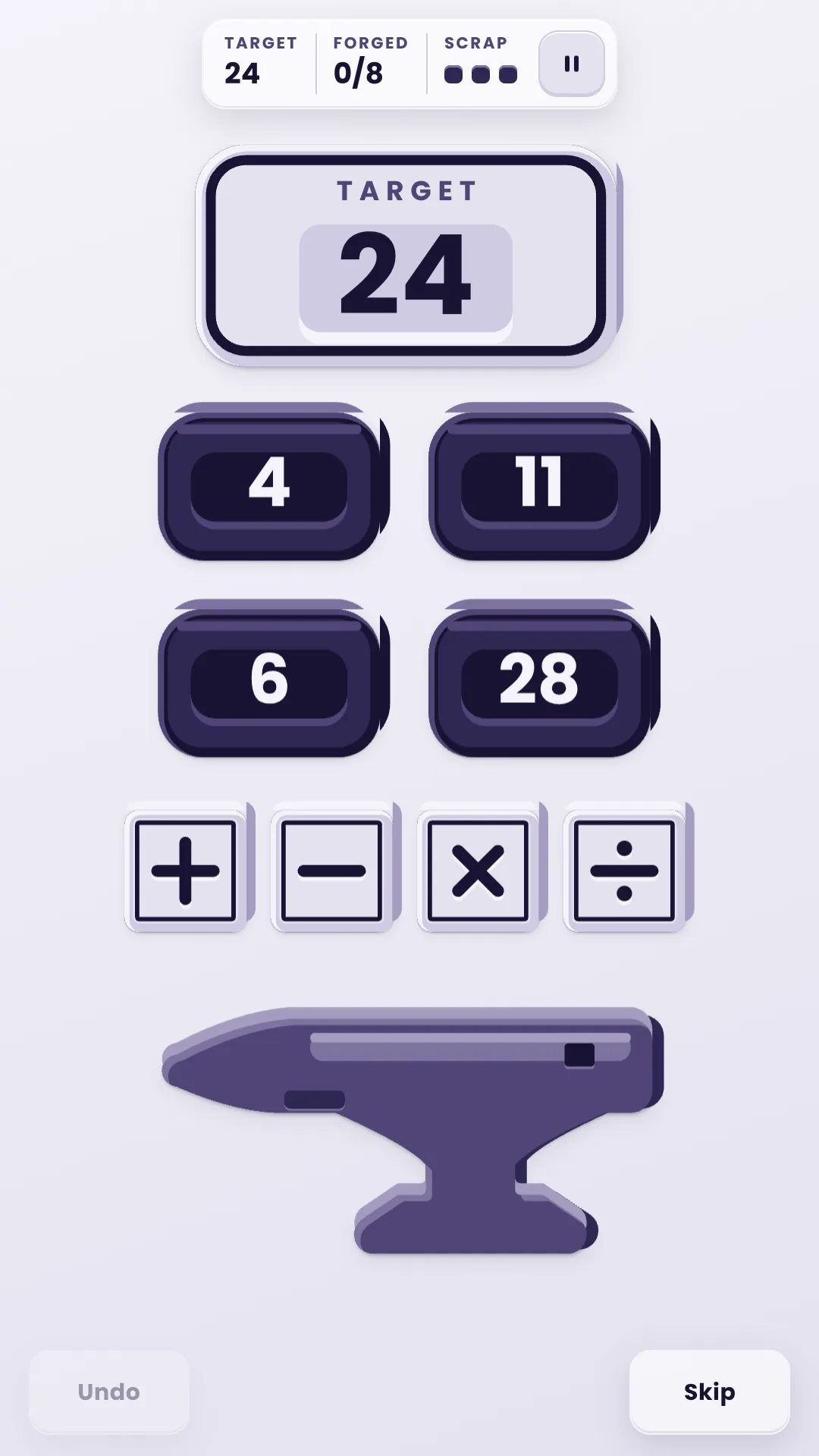
Four numbered ingots lie on an anvil bench with a target number on a plaque above them. You arm one of the four operators from the rail, tap two ingots, and they fly together and fuse into a single ingot carrying the result. Four becomes three, three becomes two, two becomes one. If that last ingot reads the target, the forge accepts it.
The arithmetic is kept honest. A subtraction that would go negative and a division that would leave a remainder are both refused at the strike, so the game never hands you a fraction and never quietly rounds. The refusal is a shake and a darker operator chip, and nothing is consumed, so a wrong pairing costs you nothing but the time to notice.
Undo is free and unlimited, and it restores the operator you had armed alongside the ingots. A dead end is therefore never a loss, only a step backwards. The only thing that can end a run is pressing Skip, which throws the current puzzle away and spends one of three scrap tokens.
Eight targets forged wins. Difficulty sets both the target range and the tools: Easy gives you addition and subtraction against targets from six to thirty, Normal opens all four operators across ten to sixty, and Hard runs from twelve to a hundred while refusing to generate a puzzle that falls out by fusing the leftmost pair over and over.
What is different about this version
Puzzles are generated backwards. The game starts at the target and splits it into two numbers through one of the allowed operations, then splits one of those, then one of those again, until four numbers exist — which means a solution was used to build the board and cannot be missing from it. A brute-force solver then re-derives a path before the ingots are ever drawn, so the generator is checked rather than trusted. The same function that decides whether a fusion is legal is the one the solver uses, so anything the solver counted on is something your hands can actually do. Boards are filtered afterwards too: no more than one ingot showing 1, nothing above the difficulty's cap, and outside Easy a set whose four numbers simply add up to the target is thrown out. Hard adds one more filter, discarding any board that can be solved by repeatedly fusing the leftmost pair, so the order you pick the ingots in has to be a real decision.
How to play Number Forge
- Tap an operator chip on the rail to arm it, or press the matching key.
- Tap two ingots. The first one you tap is the left-hand operand, which matters for subtraction and division.
- The pair fuses into a single ingot carrying the result, and the board re-centres around what is left.
- Keep fusing until one ingot remains. If it reads the target, the puzzle is forged.
- Undo as often as you like; it costs nothing and restores the armed operator.
- Forge eight targets to win. Skip spends a scrap token, and spending the last one ends the run.
Controls
| Desktop | Click an operator chip or press +, -, * and / to arm it, then click two ingots. Clicking a selected ingot deselects it and clicking the armed chip disarms it. Z undoes, and Escape or P pauses. |
|---|---|
| Phone or tablet | Tap an operator chip, then tap two ingots. Undo and Skip buttons sit along the bottom, clear of the anvil. |
| Players | One player. Any other characters on screen are run by the game. |
Strategy
Factor the target before you look at the ingots. On Normal and Hard the target was built by splitting, so it usually carries a divisor sitting in plain sight among the four numbers, and spotting that a target of eighty-four wants a twelve and a seven collapses the search immediately. When nothing factors cleanly, look for the pair whose sum or difference lands on a factor of the target instead, since the backwards generator often hides one operation under another. Multiplication is the operation to plan around because it is the only one that can move you a long way in a single fuse, so decide where it goes first and let addition and subtraction fill the gaps. Undo is free, so once you have a candidate, take the first fusion and look again rather than solving the whole chain in your head; three ingots are much easier to read than four.
Mistakes that cost you the game
- Tapping the ingots in the wrong order. The first one is the left operand, so seven then three subtracts to four, and three then seven is refused.
- Treating a refusal as a dead end. Nothing is spent; the fusion simply never happened.
- Pressing Skip on a hard-looking board. Undo can walk back every move, so skipping trades a token for a puzzle you could still solve.
- Fusing left to right out of habit. On Hard the generator specifically rejects boards that work that way.
- Forgetting to disarm. The operator stays armed after a fuse, so the next two taps use it whether you meant them to or not.
Tips
- Read the target for its factors before you read the ingots.
- Plan where the multiplication goes, then fill in around it.
- Take one fusion and re-read the board; three numbers are far easier than four.
- A division that leaves a remainder is refused, so you can test one safely at no cost.
- Easy removes multiplication and division entirely, which makes it a different puzzle rather than a slower one.
Questions about Number Forge
Can a puzzle be unsolvable?
No. Each board is assembled by splitting the target apart through the allowed operations, and a solver then finds a path through it before it is shown.
What happens to fractions and negative numbers?
They are refused at the strike. A division with a remainder and a subtraction that would go below zero both shake and produce nothing, and neither costs you anything.
How can I lose?
Only by pressing Skip three times. There is no timer and nothing drains, and undo will always take you back out of a dead end.
What does Hard actually change?
Targets run from twelve to a hundred, and the generator rejects any board you could solve by always fusing the two leftmost ingots, so the order of your pairings has to be chosen.
Does it cost anything?
No. Number Forge is free to play, runs in your browser, and needs no download, install or account.
More games like this
-
 Balance ScalesA beam, a hidden shape and a tray of weights, with one arrangement that sits level
-
 Math CagesIrregular cages, one arithmetic target each, and a grid that only has one way to fill it
-
 3072 MergeSlide a 4x4 grid, fuse matching tiles, and try to build the 3072
-
 Fold LabFold nets into cubes and punch folded paper, all in your head