
Math Cages
Irregular cages, one arithmetic target each, and a grid that only has one way to fill it
About Math Cages
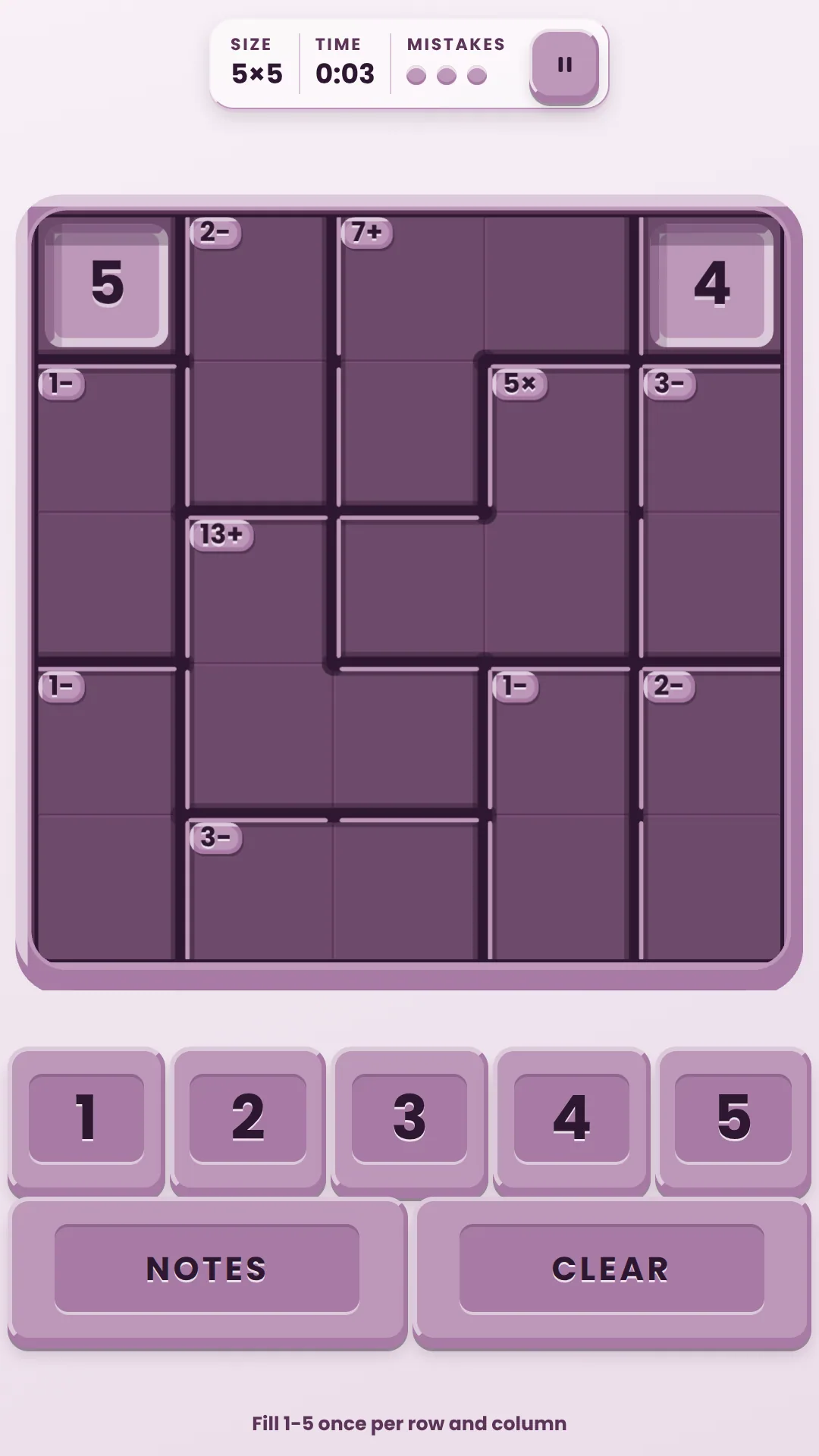
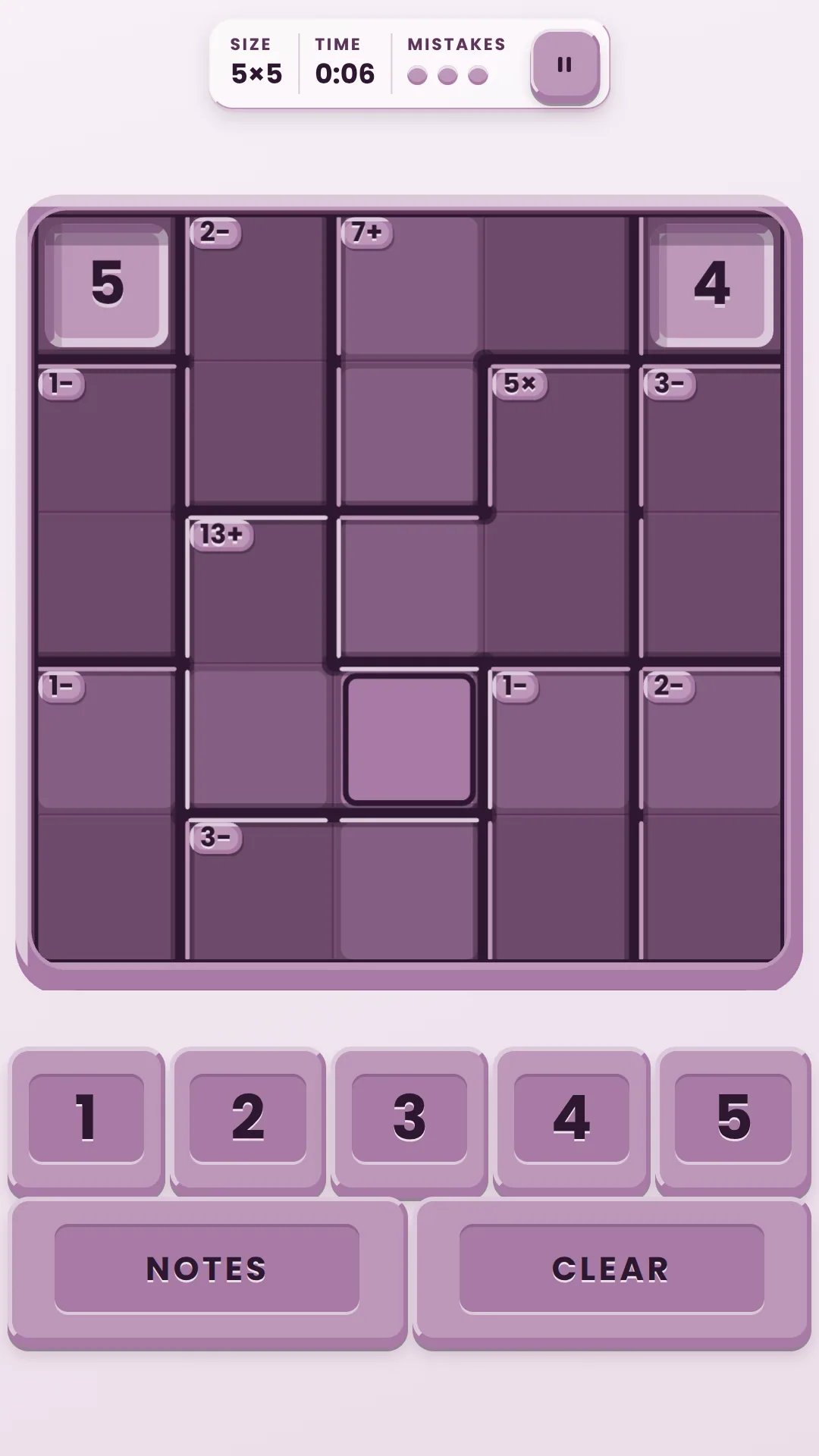
A square grid is cut into irregular cages, each carrying a small target engraved in its top-left corner: 12x, 3-, 7+, 2/. Fill the grid so every row and every column holds the digits 1 to n once each, and so the numbers inside each cage combine with that cage's operation to make its target. Subtraction and division cages are always two cells and work in either order, so a 3- cage is satisfied by 4 and 1 as readily as by 1 and 4. Addition and multiplication cages can be any size up to five.
The work is deduction rather than reaction. You look for the cage that can only be one thing — a two-cell 7+ on a 4x4 has to be 3 and 4 — place it, and let that rule digits out of its row and its column. Then you look for the next one. A one-cell cage shows its number bare with no operator and is filled in from the start, so every puzzle opens with a few cells already committed.
A digit that would repeat in its own row or column is refused as you try to place it. The cell shakes, both ends of the clash step darker for a moment, and nothing is spent. That means a grid you have filled completely can only ever be wrong on cage arithmetic, which is the part you were thinking about anyway.
Three mistake tokens, and a token is charged only when you fill the last empty cell and a cage misses its target. The cages at fault pulse once and the board is left exactly as it is, so you carry on from where you are rather than starting over. The clock in the HUD counts up and is a score, not a limit.
What is different about this version
No puzzle reaches the screen until it has been proved to have exactly one solution. The generator builds a random Latin square, floods it into cages, then picks an operation that genuinely works on the solution's values for each one — subtraction and division only where two cells hold numbers that allow it — and computes the target from there. Every cage is then expanded into the full list of value assignments that satisfy it, and a propagator narrows the candidates cell by cell using cage arithmetic, peer elimination and hidden singles. If propagation resolves every cell to a single candidate, the puzzle has at most one solution and one is already in hand, so the count is exactly one without a search at all. Anything propagation cannot finish goes to a backtracking solver that counts solutions and stops at two, and the puzzle is discarded unless the count comes back as one. Puzzles that need guessing are thrown away too, so the grid always yields to reasoning. Hard adds one further test: a second solver pass is run without hidden singles, and if that alone finishes the puzzle it is rejected, which guarantees at least one point where cage arithmetic runs out and only a row or column elimination will move you forward.
How to play Math Cages
- Tap a cell to select it, then tap a number on the pad or press the matching key.
- Read the target in a cage's top-left corner: 12x means the cage's numbers multiply to twelve, 3- means the two cells differ by three.
- Every row and every column must hold each digit from 1 to the grid size exactly once.
- A digit that would repeat in its row or column is refused before it lands and costs nothing.
- Turn on NOTES to write pencil marks into a cell's corner; a placement clears that digit from the marks in its row, column and cage.
- Fill the last cell with every cage correct to solve the grid. A full grid with a cage wrong costs one of three mistake tokens.
Controls
| Desktop | Click a cell or move the selection with the arrow keys, then press a digit key or click the pad. 0, Backspace or Delete clears the cell, N toggles pencil marks, and Escape or P pauses. |
|---|---|
| Phone or tablet | Tap a cell, then tap a key on the pad below the grid. NOTES and CLEAR sit at the end of the pad, and nothing ever covers the board. |
| Players | One player. Any other characters on screen are run by the game. |
Strategy
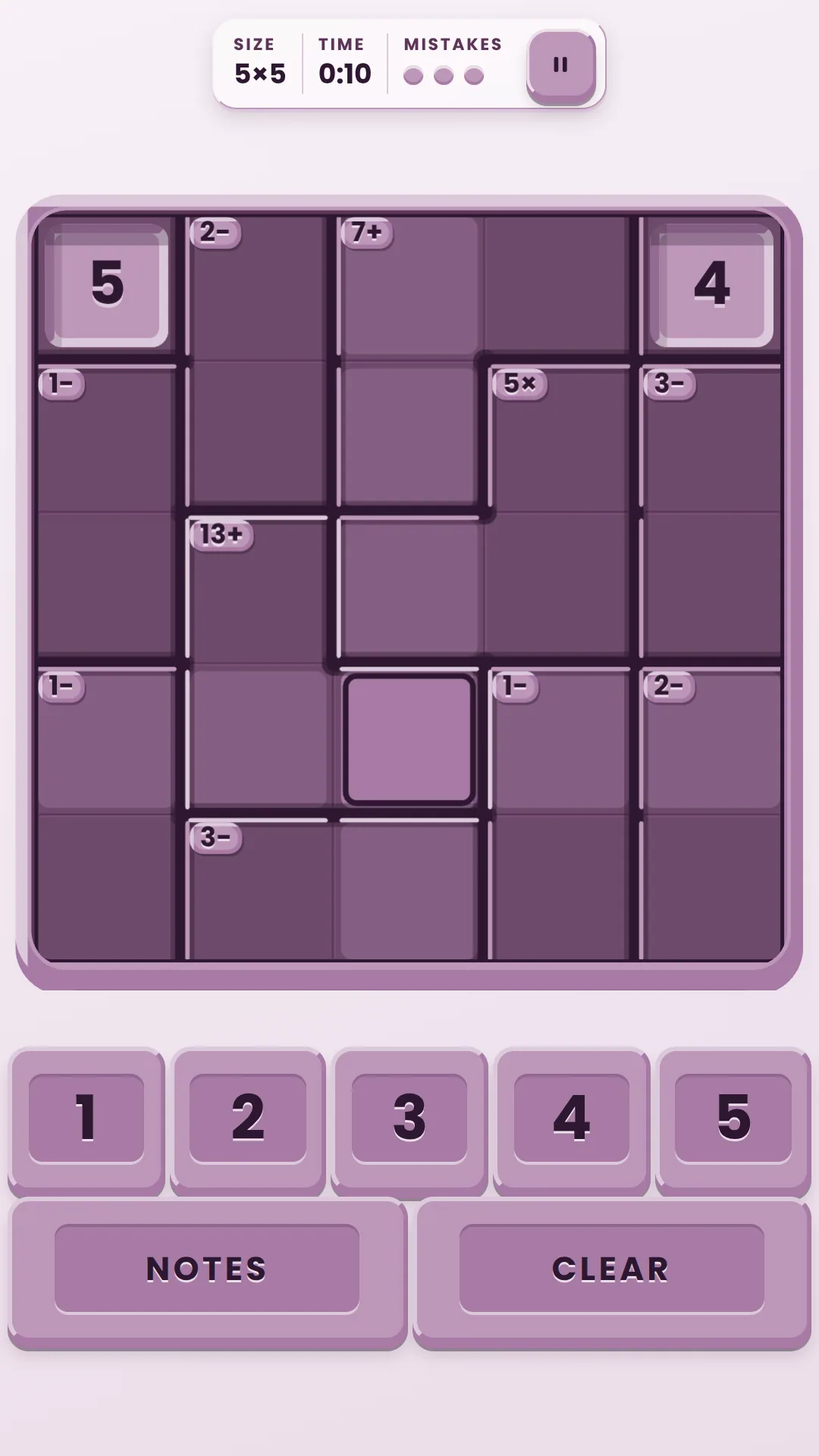
Start from the cages whose arithmetic has the fewest ways to come out. Small targets on addition cages and large ones on multiplication cages are the tightest: a 3+ two-cell cage is 1 and 2 in some order on any grid size, and a 30x two-cell cage on a 6x6 must be 5 and 6. Division cages are quietly the most informative of all, because a 3/ cage on a 6x6 can only be 1 and 3 or 2 and 6, and a 2/ cage is down to three possibilities before you look at anything else. Once you have a pair narrowed to two orders, do not guess between them; write both as pencil marks and go and find the row or column that decides it. That is the whole rhythm of the game, and on Hard it is compulsory, because the generator refuses to ship a 6x6 that cage arithmetic alone can finish. When you stall, count a row: if five of its six cells have a digit ruled out, the sixth is where it goes, and that single elimination usually unlocks two or three cages at once.
Mistakes that cost you the game
- Filling the last cell to see whether the grid is right. That is the only act that can cost a token, and the board would have told you nothing sooner.
- Reading a subtraction or division cage in one direction. Both are order-free, so a 2/ cage is 2 over 1 or 1 over 2 and you cannot tell which yet.
- Guessing between two candidates rather than noting both. Every puzzle is solvable by reasoning, so a guess is always avoidable and usually wrong.
- Forgetting the single-cell cages. They are already filled in and locked, and they eliminate digits from their rows and columns from the first second.
- Treating a refused digit as a mistake. A repeat in a row or column never lands and never costs anything.
Tips
- Work the extreme targets first: the smallest sums and the largest products have the fewest arrangements.
- Division cages narrow faster than any other kind; find them early.
- Write both orders of a pair as pencil marks and let a row or column decide between them.
- Placements clear pencil marks from the row, the column and the cage automatically, so marking freely costs nothing to maintain.
- Best times are only recorded for a solve with all three tokens intact, so accuracy is worth more than pace.
Questions about Math Cages
Can a puzzle have more than one solution?
No. Each one is either resolved to a single candidate per cell by propagation, which proves uniqueness outright, or handed to a solver that counts solutions and stops at two. Anything that does not come back with exactly one is discarded and regenerated.
How do I lose a mistake token?
Only by filling the final empty cell with a cage that misses its target. The cages at fault pulse once, the board stays exactly as you left it, and you keep working. Losing the third token ends the run.
Is the clock a time limit?
No. It counts up and is only a score. Nothing in the game is on a timer and no puzzle expires.
What changes between the difficulties?
Easy is a 4x4 with cages of two or three cells and only addition and multiplication. Normal is a 5x5 with cages up to four cells and all four operations. Hard is a 6x6 with cages up to five cells, all four operations, and a generator that rejects any puzzle solvable by cage arithmetic alone.
Does it cost anything?
No. Math Cages is free to play, runs in your browser, and needs no download, install or account.
More games like this
-
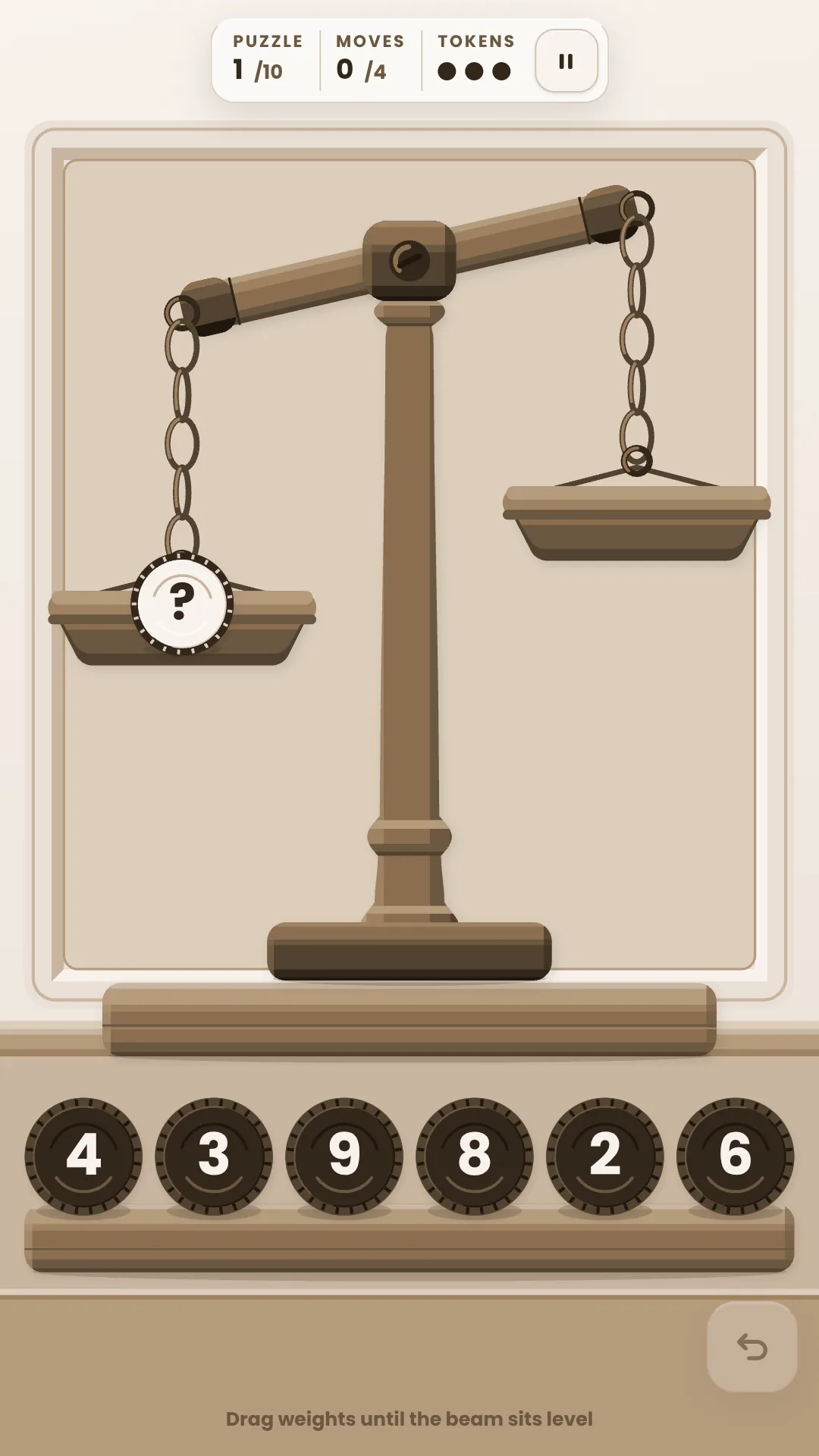 Balance ScalesA beam, a hidden shape and a tray of weights, with one arrangement that sits level
-
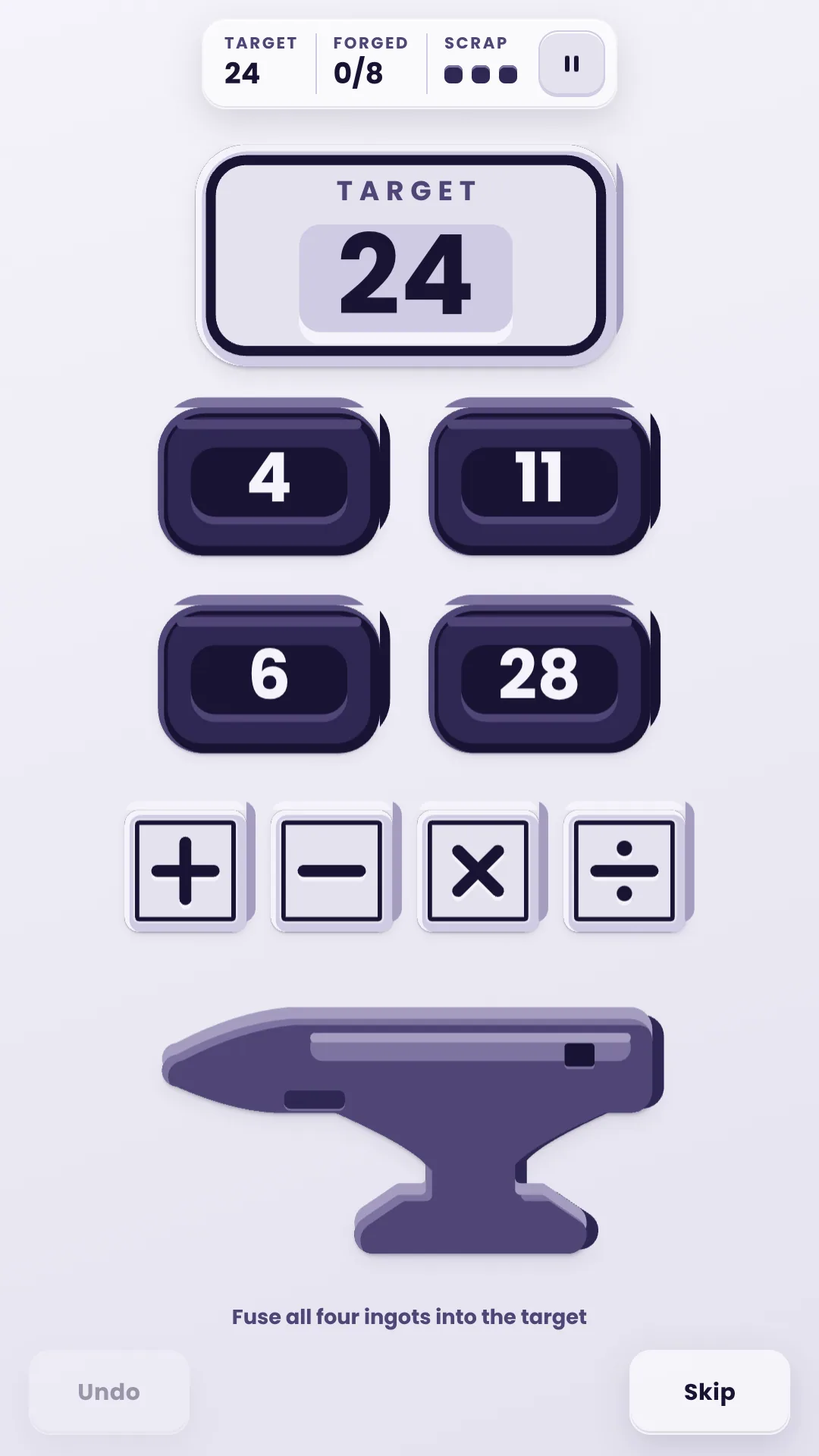 Number ForgeFour ingots, one target, and every puzzle built backwards from a solution that exists
-
 3072 MergeSlide a 4x4 grid, fuse matching tiles, and try to build the 3072
-
 Fold LabFold nets into cubes and punch folded paper, all in your head