
Snake & Ladder
Ten snakes, nine ladders, and a finish line you have to hit exactly
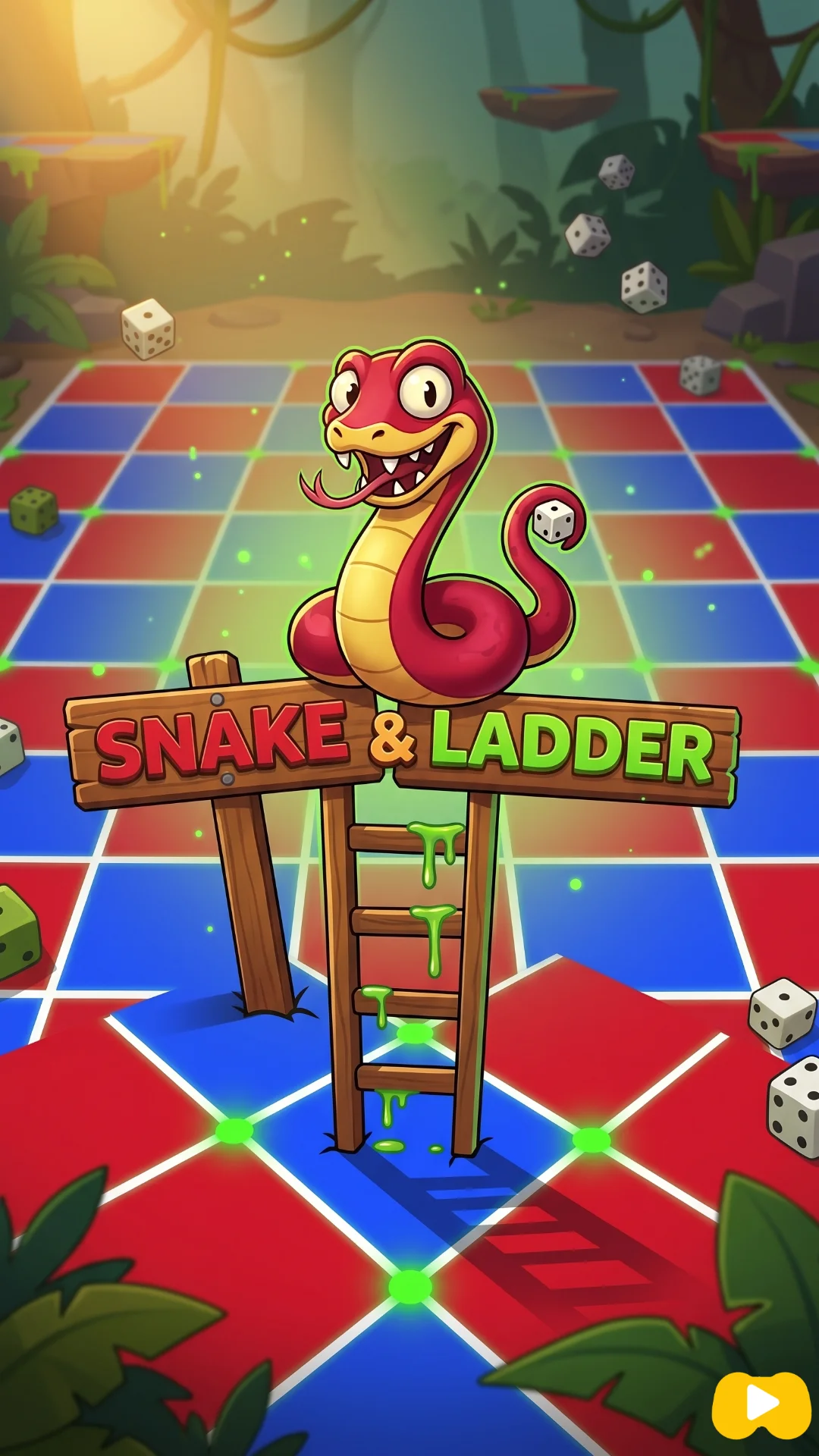
About Snake & Ladder
The board is fixed, which is the first thing worth knowing. Nine ladders and ten snakes sit in the same places every match: the long climb from 28 up to 84, the ladder at 80 that drops you straight onto 100, and a cluster of snake heads at 87, 93, 95 and 98 guarding the last stretch. Tokens start on tile 1, not off the board, and the die is a plain one to six, with no bonus roll for a six and no way to knock anyone off a tile.
There are no decisions to make anywhere in it, and pretending otherwise would be silly, so what you are really playing for is the shape of the swing. A run of good rolls in the twenties can carry someone from the bottom row to the fourth, and a single unlucky roll at 93 can hand the lead back. Play it against the computer, or pass one phone around a table of up to four. Most matches take two or three minutes, which makes best-of-three the sensible unit.
What is different about this version
The board does not shuffle between matches, so the hazards are learnable rather than random furniture. Ladders wait at 2, 4, 9, 21, 28, 36, 51, 71 and 80; snakes bite at 16, 47, 49, 56, 62, 64, 87, 93, 95 and 98. Several house rules are deliberately absent: rolling a six does not earn another turn, landing on another player's tile does nothing, and there is no rule sending you back to the start. The exact-finish rule is kept, and it bites hard, because a token parked on 97 sits still through every roll except a three. Against the computer the game also keeps a running record of how many matches you have won.
How to play Snake & Ladder
- Choose two, three or four players, against the computer or passing the device around.
- Roll the die and your token walks that many tiles.
- Land on the foot of a ladder and climb; land on a snake's head and slide to its tail.
- Reach tile 100 on an exact count to win. Overshoot and you do not move at all.
Controls
| Desktop | Press Space or click the die to roll; Escape pauses the match. |
|---|---|
| Phone or tablet | Tap the die to roll. Everything else plays itself. |
| Players | One or two people on the same device. Nothing here plays over the internet. |


Strategy
Nothing you do changes the outcome, so the honest strategy here is knowing what the board is about to do to you. The top row is the dangerous one. From tile 94, a six wins outright, but a one drops you to 95 and then a snake to 75, and a four lands on 98 and sends you to 78. Two of the six faces cost you roughly twenty tiles. That is why a commanding lead at 90 is worth far less than it looks and why the player sitting on 60 is rarely out of it. The ladder at 80 is the single most valuable tile on the board because it ends the game on the spot. The ladder at 28 is the second, lifting you fifty-six tiles into the fourth row in one step. Between them is the quiet stretch from 65 to 79, which has one ladder and three snakes, and is where most of the lead changes actually happen.
For the exact-finish rule, the useful observation is that every face is equally likely, so being one tile short is no better than being five short. What matters is how many faces overshoot: from 96 only four of six rolls are legal moves at all, so the last few tiles pass slowly while someone behind you is still climbing. Play best of three, keep celebrations quiet until a token is actually on 100, and let the four-player game take a bit longer between your turns.
Mistakes that cost you the game
- Treating the nineties as home ground. Four of the last fourteen tiles are snake heads, and two of them cost more than sixty tiles.
- Counting the run to 100 as though any roll will do. Overshooting forfeits the move entirely, so a lead can stall for several turns while someone behind climbs.
Tips
- Remember tile 80. It is the only ladder that ends the match immediately, and it is worth watching for in everybody's count.
- Pick two players if you want a quick match; four tokens roughly doubles the wait between your own rolls.
- Keep score across three matches rather than one. A single game is usually decided by two rolls.
Questions about Snake & Ladder
Does rolling a six give me another turn?
No. Every roll passes the die along, whatever the number. It keeps matches short and stops one hot streak from running away with the game.
Can I land on another player and send them back?
No. Tokens share tiles happily and sit side by side, so there is no capturing to argue about.
What happens if my roll goes past 100?
You stay where you are and the turn passes. You need the exact number, which is why the last few tiles can take several attempts.
How many people can play on one device?
Up to four. In pass-and-play everyone takes the handset in turn; against the computer you take the first token and the rest are played for you.
Is the board the same every time?
Yes, every snake and ladder keeps its position. Nothing is generated at random except the rolls themselves.
Does it cost anything?
No. Snake & Ladder is free to play, runs in your browser, and needs no download, install or account.
More games like this
-
 LudoFour colours, one board, and the arguments your family has been having for years
-
 Bigger Tic Tac ToeNine small boards inside one big one, and your square picks where your opponent plays
-
 Carrom ClashSlide the striker, pull back, release — nineteen pieces and a queen that must be covered
-
 ChessEvery rule of chess, and an opponent that never looks at your reply