
Ludo
Four colours, one board, and the arguments your family has been having for years

About Ludo
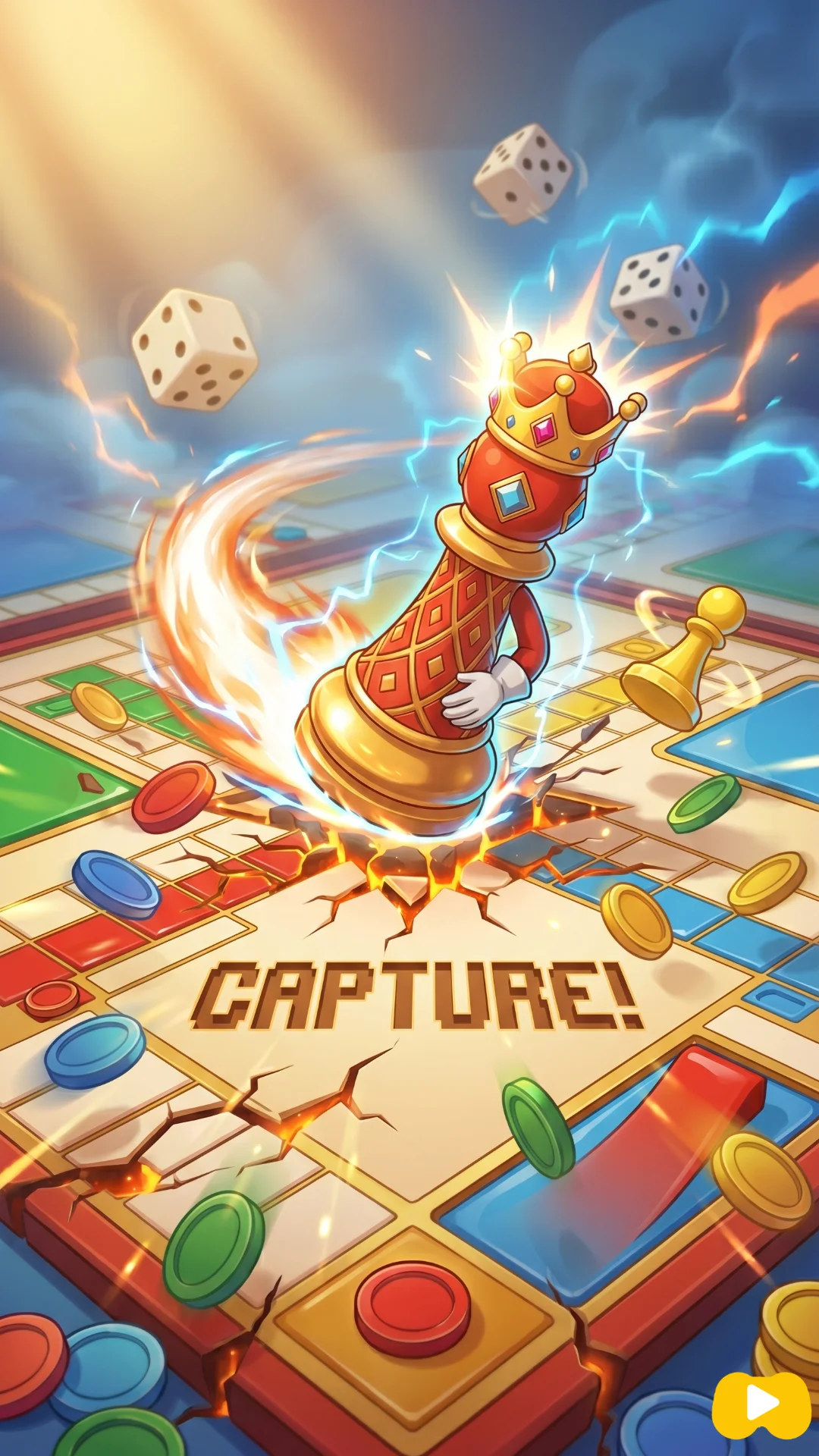
Ludo needs no introduction anywhere between Karachi and Chennai, so this version does not try to reinvent it. Four colours, four tokens each, a fifty-two square loop and a six-square run home. You need a six to get out of the yard, a six or a capture buys you another roll, and the first colour to walk all four tokens home wins.
What it does do is get out of the way. The board is pixel art, the dice is one big button, and every token you may move glows, so a turn is two taps. Play against three CPU opponents, or hand the phone round the room in pass and play, where all four colours are human.
The rules kept are the ones people actually agree on. Eight squares are safe: each colour's entry square plus the four stars between them. Three sixes in a row hands your turn over, and landing exactly on home is required, so a token four steps out waits for someone to roll a four. A game runs five to eight minutes.
What is different about this version
No house rules were bolted on — no double-token blockades, no bonus squares, no dice rigged for drama. Two of your own tokens can share a square, but they do not block anyone passing. The attention went into the opponent instead. Each CPU scores every legal move against fixed priorities: reaching home is worth most, then each capture, then getting a token out of the yard, then crossing into the home lane, then landing safe, then fleeing a square an opponent can reach with one roll. A small random weighting sits on top, deliberately: without it the three CPUs play identically and you read the board a turn ahead. It also means they sometimes take a greedy capture, because the capture score drowns out the danger score.
How to play Ludo
- Tap the dice to roll. You need a six to move a token out of the yard.
- Tap a glowing token to move it that many steps around the loop.
- Land on an opponent's token to send it home — unless it stands on one of the eight safe squares.
- A six or a capture earns another roll. Three sixes in a row and the turn passes.
- Past the loop, tokens turn into their own home lane, where nothing can touch them.
- The exact number finishes a token. All four home wins.
Controls
| Desktop | Click the dice button to roll, then click whichever token is glowing. |
|---|---|
| Phone or tablet | Tap the dice, then tap a glowing token. Nothing else is needed. |
| Players | One or two people on the same device. Nothing here plays over the internet. |

Strategy
The safe squares are not scattered at random. Counting from your own entry square they sit at steps 0, 8, 13, 21, 26, 34, 39 and 47 — a repeating pattern of eight, then five, then eight. A token on a star needs a five to reach the next safe square; a token on an entry square needs an eight, which means two rolls and a nervous turn in the open. Plan your stops around that rhythm and you spend most of the game untouchable.
Threat range is exactly one to six squares behind you, so look back before committing. The CPU weights a capture at several times the value of anything else, which cuts both ways: park a token seven or more steps ahead of the nearest enemy and it is genuinely ignored, but leave one five ahead and everything in range comes for it, sometimes abandoning a better move to do so.
Spreading beats sprinting. A six lets you leave the yard or move a piece and grants a bonus roll either way, so getting a second and third token out early compounds: more tokens means more legal moves, and better odds one of them is a capture or a safe landing. A lone runner has no options at all, and the turn it lands four short of home it becomes a spectator.
Mistakes that cost you the game
- Spending every six on the leading token. A six is also your only way out of the yard, and a board with one token on it has one move.
- Stopping on an ordinary square five or fewer steps ahead of an enemy. That is inside capture range, and the CPU values captures above all else.
- Shoving a token to within two of home early. It sits there doing nothing until the exact number turns up.
Tips
- Count backwards, not forwards. Whether the landing square is safe matters more than how far it moved you.
- A capture buys another roll, so chain them — one capture landing you on a star and handing back the dice is worth two turns.
- In pass and play, going last is not the disadvantage it feels like. Everyone needs the same six to start.
Questions about Ludo
How many players are there?
Four colours always play. Against the CPU you take one and three are played for you; in pass and play all four are people sharing the device.
Are there blockades?
No. Your tokens can stack, but they will not stop anyone landing there or passing through.
What counts as a safe square?
The four coloured entry squares and the four stars between them.
Why did my turn end after three sixes?
Standard rule, enforced here. The third six is void and play moves on.
Can I move if I roll a six with nothing to do?
You roll again. A six with no legal move does not waste the turn.
Does it cost anything?
No. Ludo is free to play, runs in your browser, and needs no download, install or account.
More games like this
-
 Snake & LadderTen snakes, nine ladders, and a finish line you have to hit exactly
-
 Bigger Tic Tac ToeNine small boards inside one big one, and your square picks where your opponent plays
-
 Carrom ClashSlide the striker, pull back, release — nineteen pieces and a queen that must be covered
-
 ChessEvery rule of chess, and an opponent that never looks at your reply