
Math Duel
Fifteen questions, four tiles, and a wrong tap costs you a point and your turn
About Math Duel
Math Duel is a race to answer, not a quiz. Fifteen questions per match, four answer tiles under each, and whoever taps the right one first takes the point. Getting it wrong costs a point and locks you out of that question while your opponent still has time to take it. A ring around the card counts the seconds down and starts ticking audibly near the end.
The questions start as plain arithmetic and grow. The first three are always straightforward, the level steps up every six questions, and from level two onwards a share of them become puzzles instead: a missing number, a five-term sequence to continue, or an equation with the operator removed and four symbols to choose between.
It suits two people on either side of one phone, and works as a short, honest drill for one. Nothing about it is dressed up as a lesson, which is probably why it survives being played voluntarily. A match takes about two minutes, and your best score is remembered between them.
What is different about this version
The CPU does not react to you. When a question appears it draws a single answer time from a range and commits to it — roughly four to six and a half seconds on Easy, just over one to two on Hard — and separately rolls whether it will get the answer wrong at all. You are racing a stopwatch, which makes the game honest about what it is testing. The wrong answers are designed too: the three distractors are built from the true answer plus or minus one, plus or minus two, and plus or minus ten, so a tile that looks nearly right is exactly the trap. Puzzle questions carry twelve seconds instead of ten, and the CPU is deliberately slowed on them.
How to play Math Duel
- Choose vs CPU or 2 Players, and Easy, Normal or Hard.
- A question appears for both sides at once, with the same four options.
- Tap or key your answer as soon as you are sure of it.
- A correct answer scores; a wrong one costs a point and shuts you out of that question.
- After fifteen questions the higher score takes the duel.
Controls
| Desktop | Player 1 answers with 1, 2, 3 and 4; Player 2 with 7, 8, 9 and 0. The tiles are clickable as well. |
|---|---|
| Phone or tablet | Each player taps the four tiles on their own side; in two-player the upper half is mirrored so it reads the right way up from across the table. |
| Players | One or two people on the same device. Nothing here plays over the internet. |
Strategy
Answer with a check, not a calculation. Since every distractor sits within ten of the correct value, the last digit almost always separates them: for a multiplication you rarely need the full product, only the units digit and a rough size. Seven times eight against tiles reading 54, 56, 58 and 66 is a one-digit decision.
The minus-one penalty makes guessing strictly worse than waiting. A wrong tap costs a point and removes you from the question, so with a tie or a one-point lead on the line, letting the clock run beats a coin flip. The exception is Hard, where the CPU commits to answering inside about two seconds and anything you have not solved by then is usually gone regardless.
Sequences reward looking at the gaps rather than the terms. The generator builds arithmetic runs, doublings and triplings, square numbers, and runs whose gap itself grows by a fixed step, so writing the differences in your head identifies the type immediately. Mystery-operator questions are faster still: check divisibility first, because two numbers that do not divide cleanly eliminate a symbol before you have done any arithmetic at all. And remember the level only climbs every sixth question, so the back third of a match is where the puzzles cluster — bank the easy points early rather than pacing yourself.
Mistakes that cost you the game
- Tapping the nearest-looking tile when unsure. The near misses exist precisely because they are one or two away.
- Doing full long multiplication under time pressure when the units digit would have chosen the tile.
- Guessing while ahead — losing a point and the question is a two-point swing.
- Treating the last third like the first, when the level has ramped and puzzles are at their most common.
Tips
- The first three questions are always plain arithmetic with no puzzle possible. Bank them.
- On a sequence, work out the differences between terms before looking at the options.
- On Easy the CPU takes four seconds or more and misses about a third, so accuracy alone wins.
Questions about Math Duel
How many questions are in a match?
Fifteen, with the difficulty rising every six of them.
What kinds of question appear?
Arithmetic, two-step expressions, and from level two a share of missing-number, sequence and mystery-operator puzzles.
Does a wrong answer really cost a point?
Yes, one point, floored at zero, and you are locked out while the other side can still answer.
Can two people use one keyboard?
Yes. Player 1 uses 1 to 4 and Player 2 uses 7, 8, 9 and 0.
Why is the top half upside down?
In two-player it is mirrored for the person opposite, so both read the question the right way up.
Is it suitable for children?
Easy keeps the numbers small and gives the CPU a slow, error-prone pace, which makes it a fair drill for someone practising tables.
Does it cost anything?
No. Math Duel is free to play, runs in your browser, and needs no download, install or account.
More games like this
-
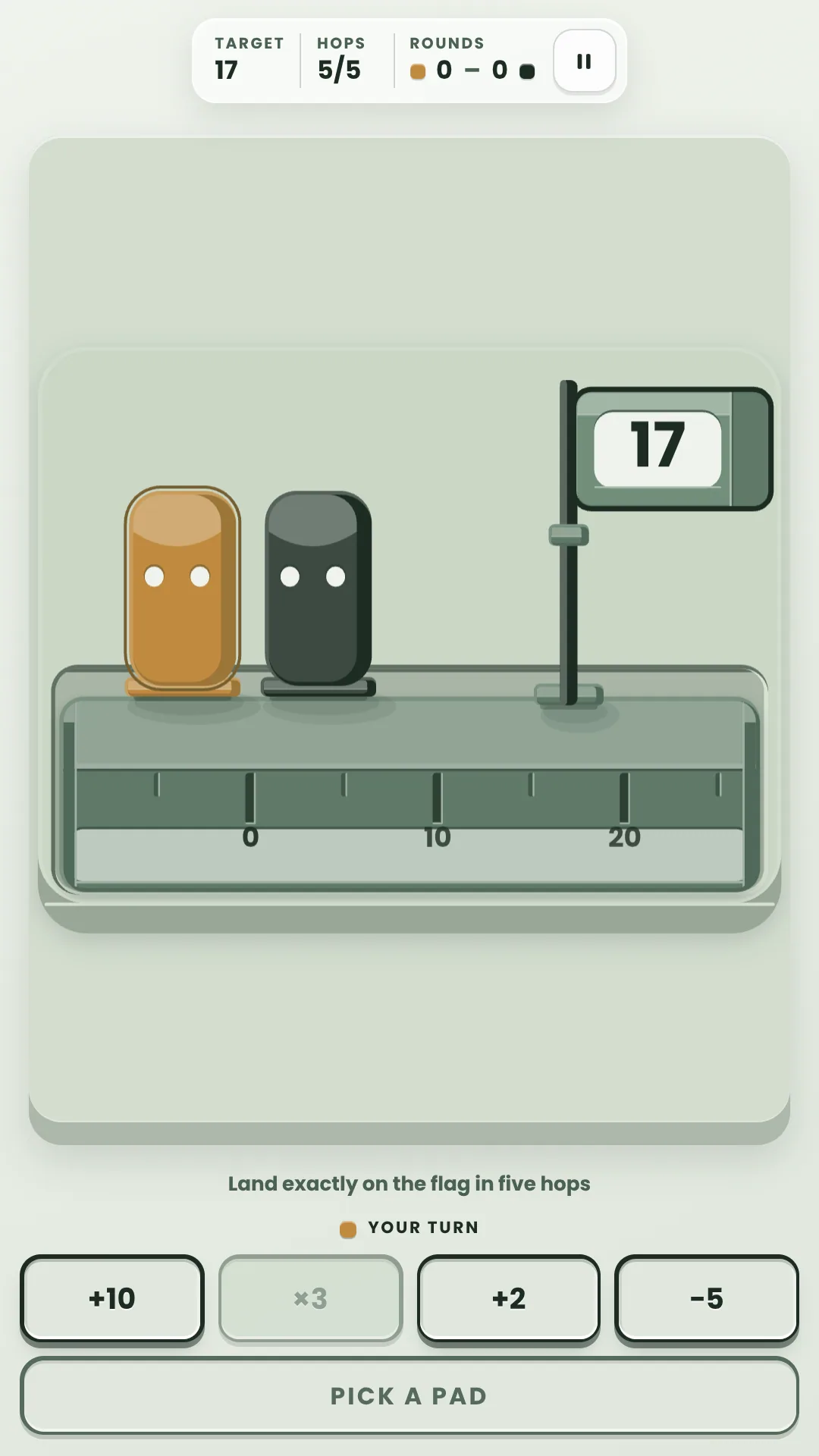 Number Line HopA hand of four operations, five hops, and a flag you have to land on exactly
-
 3072 MergeSlide a 4x4 grid, fuse matching tiles, and try to build the 3072
-
 Balance ScalesA beam, a hidden shape and a tray of weights, with one arrangement that sits level
-
 Fold LabFold nets into cubes and punch folded paper, all in your head