
Prime Grid
Thirty numbers, one rule above them, and a wrong tap costs a shield
About Prime Grid
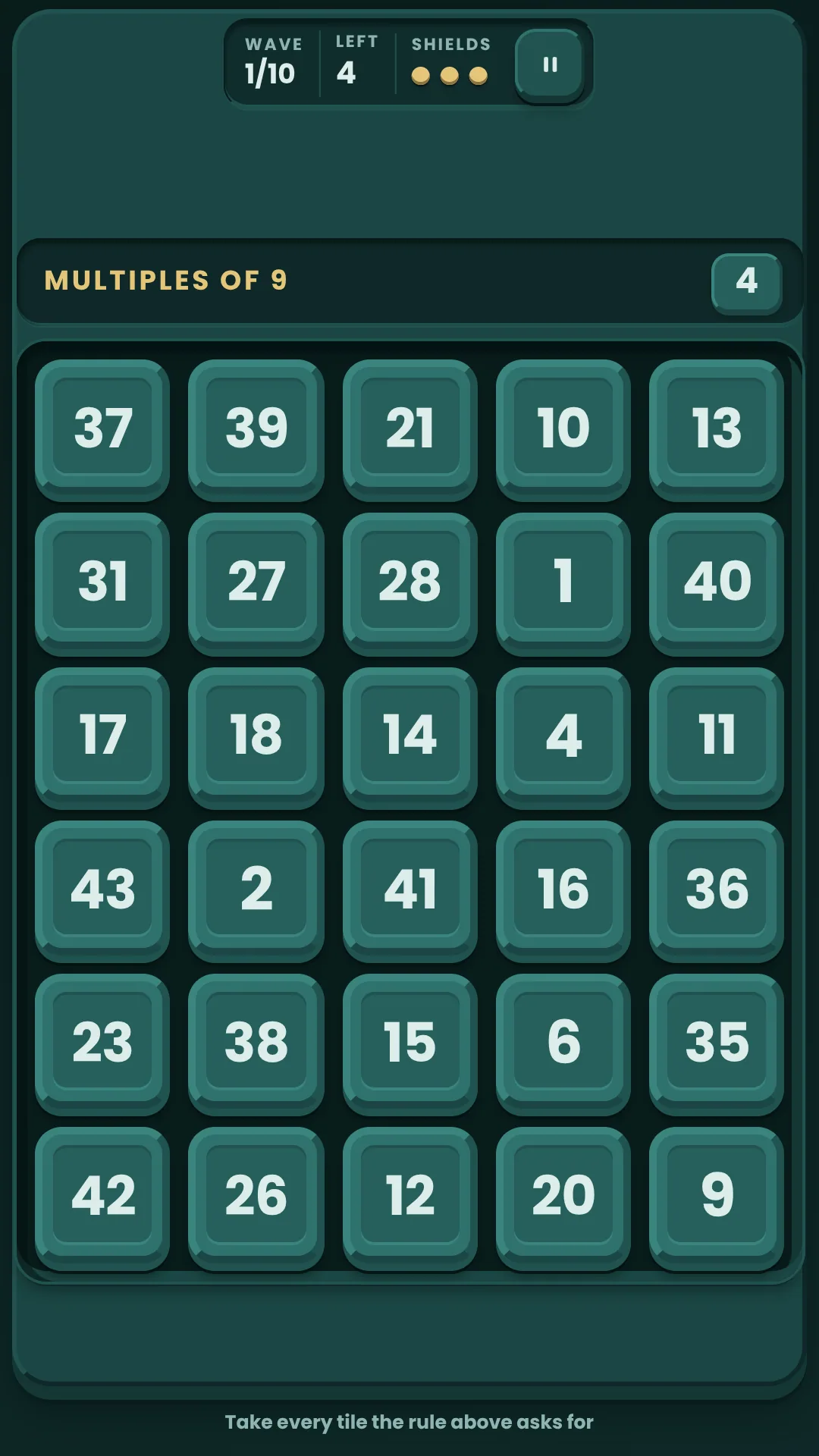
Thirty tiles sit in a five by six grid with a rule written above them: multiples of seven, primes, over fifty, even numbers, square numbers, factors of thirty-six. Tap every tile that obeys the rule. Correct tiles sink into the board and the counter on the rule bar ticks down. Clear them all and the grid slides out to the left while the next one arrives from the right carrying a new rule.
The grid is always the same size, so reading never gets harder to see. What changes is the arithmetic. Wave one asks for four matches; each wave adds one, up to a ceiling of twelve, and the number range widens as you go, which means the same sweep of the eye is doing progressively more work.
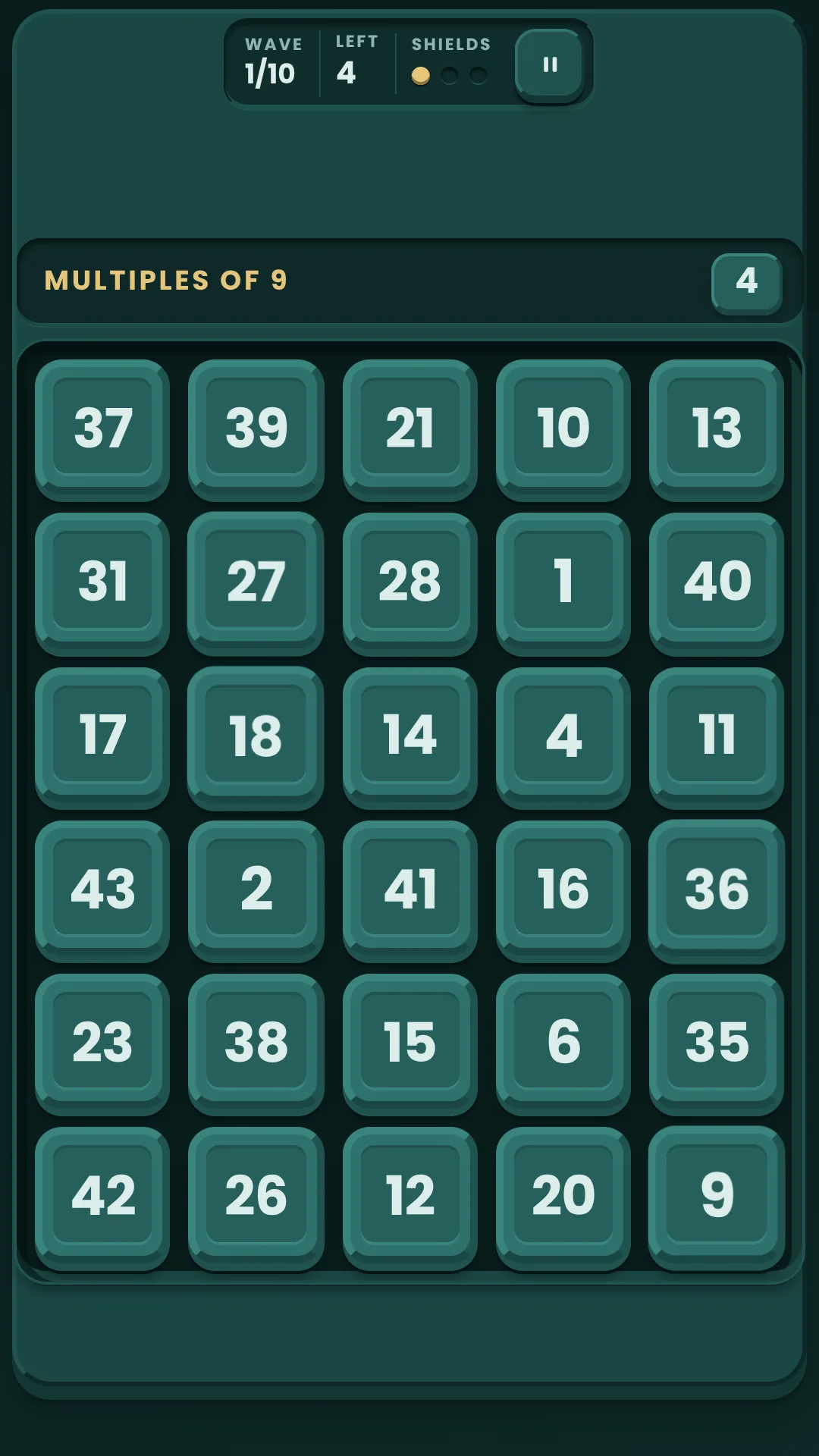
Three shields is the whole health system, and a wrong tap is the only thing that spends one. The tile shakes, steps darker and locks for six hundred milliseconds so a mash cannot cost you two at once. Tiles you have already taken are inert and tapping them again costs nothing.
There is no timer and nothing rises or falls on its own. If you sit still for six seconds without a correct tap, the matching tiles begin to breathe on a slow two-second cycle. That helper never expires and never costs anything.
What is different about this version
No board is drawn until it has been verified. After a rule and its matching numbers are chosen, the generator counts the matches in the finished thirty-tile set and throws the whole board away unless the count is exactly what the wave asked for, every number is distinct, and the total falls inside four to twelve. The rule is also checked against the previous wave's label so the same wording never appears twice in a row. Hard goes further and plants two decoys: after the board is filled, two non-matching tiles are swapped for numbers exactly one away from a real match, so a grid asking for multiples of nine will contain a 44 and a 46. The grid never reflows after a correct tap either. Taken tiles stay where they are and shrink in place, because moving the survivors would destroy the sweep that the game is built around.
How to play Prime Grid
- Read the rule on the bar above the grid and the count of matches at its right end.
- Tap every tile the rule describes. A correct tile sinks and the counter drops.
- A wrong tap costs one of three shields and locks that tile for a moment.
- Already-taken tiles do nothing, so a double tap is never punished.
- Clear all the matches and the next wave slides in with a different rule and a wider range.
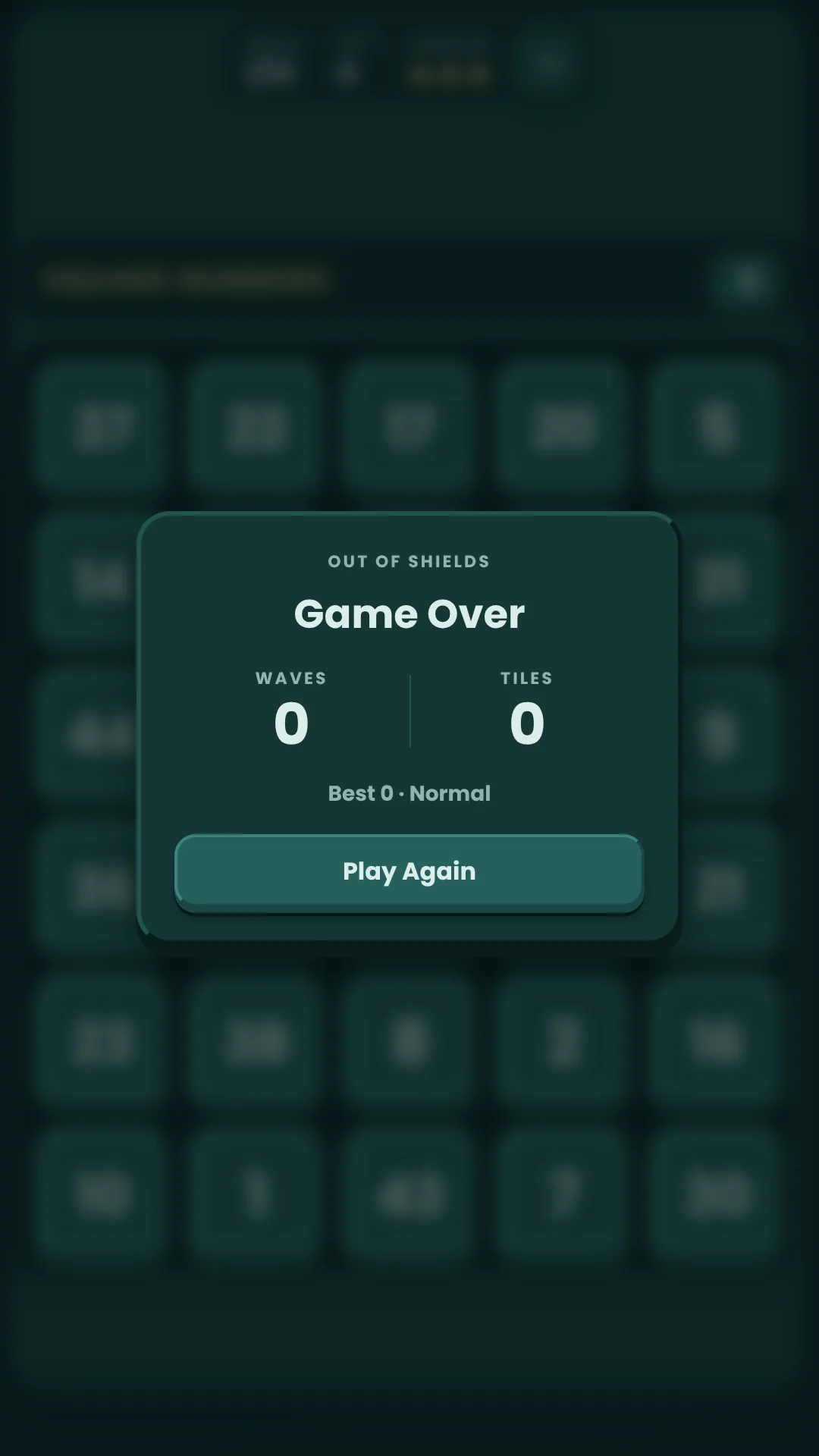
- Clear ten waves to win. Losing all three shields ends the run.
Controls
| Desktop | Click a tile. The arrow keys move a focus ring and Enter or Space takes the tile under it. Escape or P pauses. |
|---|---|
| Phone or tablet | Tap a tile. That is the only input, and the bottom of the screen is deliberately empty so the board can use the space. |
| Players | One player. Any other characters on screen are run by the game. |
Strategy
Sweep in a fixed direction rather than hunting. The board does not move, the rule does not change mid-wave, and the counter tells you exactly how many are left, so reading row by row from the top costs nothing and guarantees you see every tile once. Rules split into two kinds and they want different reading speeds: even, odd, over fifty and multiples are all single-glance tests you can run at full pace, while primes, squares and factors need a beat per tile and are where shields are actually lost. When a factor rule appears, work from the factor list rather than from the tiles — the factors of thirty-six are a short list you can hold in your head, and checking ten numbers against six remembered values is faster and safer than dividing thirty times. On Hard, slow down by one notch on any number adjacent to something you have already taken, because that is exactly where the decoys are placed.
Mistakes that cost you the game
- Tapping a number that looks prime. Fifty-one, ninety-one and one hundred and nineteen all cost a shield.
- Forgetting that 1 is not prime and not counted as one, while 1 is a square number and a factor of everything.
- Hunting around the grid instead of sweeping it. The counter already tells you how many remain, so coverage beats speed.
- Rushing the first tap of a new wave. The rule changed, and the previous rule is still in your eye.
- Trusting a near-miss on Hard. Two tiles per board are placed one away from a real match on purpose.
Tips
- Read the rule and the count together before your first tap.
- For a factor rule, recall the factor list once and check tiles against it.
- Sweep row by row in one direction so no tile is read twice.
- Stop for six seconds if you are stuck; the matching tiles start breathing and it costs nothing.
- Easy uses only even, odd, multiples and over-N rules, which is the cheapest way to learn the sweep.
Questions about Prime Grid
How many matches are in each wave?
Four on wave one, one more on each wave after it, up to a cap of twelve. The count is always shown at the right of the rule bar.
Does a second tap on a taken tile cost anything?
No. Taken tiles are inert and ignore every tap, so mashing near one is safe.
What is the breathing effect?
A helper. After six seconds without a correct tap, the matching tiles scale gently on a two-second cycle. It never runs out and it does not affect your score.
How do the difficulties differ?
Easy runs from 1 to about 40 with even, odd, multiples and over-N rules. Normal reaches 99 and adds primes, squares and factors. Hard reaches 150 with all six rules and plants two decoys one away from a real match.
Does it cost anything?
No. Prime Grid is free to play, runs in your browser, and needs no download, install or account.
More games like this
-
 3072 MergeSlide a 4x4 grid, fuse matching tiles, and try to build the 3072
-
 Ball EaterSwallow anything eight per cent smaller, and stay well clear of the spiky red one
-
 Balling BallSlide the floors under a bouncing ball and drop it through the gaps
-
 Claw CraneA candy-pink claw machine full of plush critters, and ten tokens to win them all