
Number Gates
Run a squad of counting cubes through the arithmetic that makes it big enough for the next wall
About Number Gates
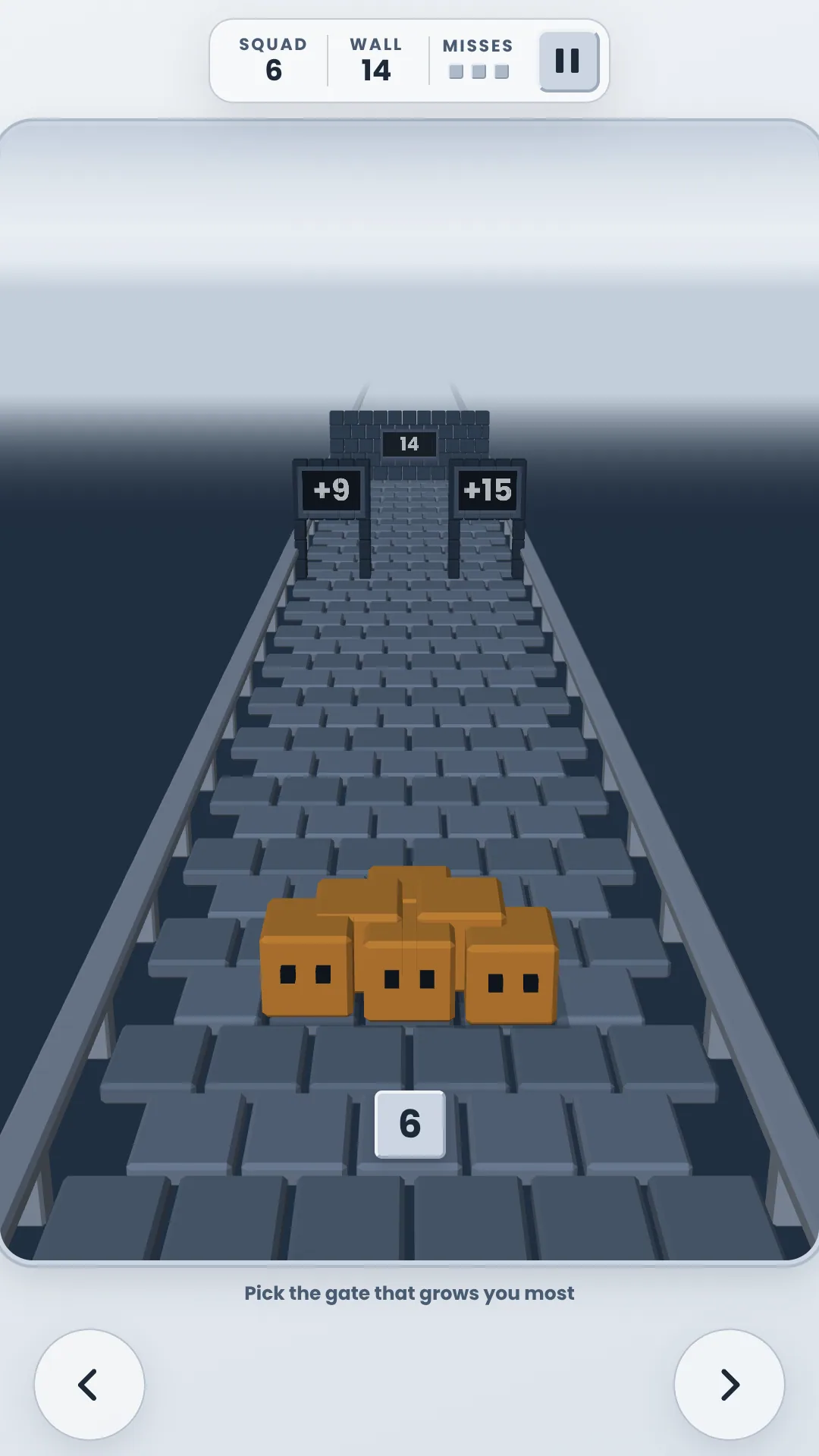
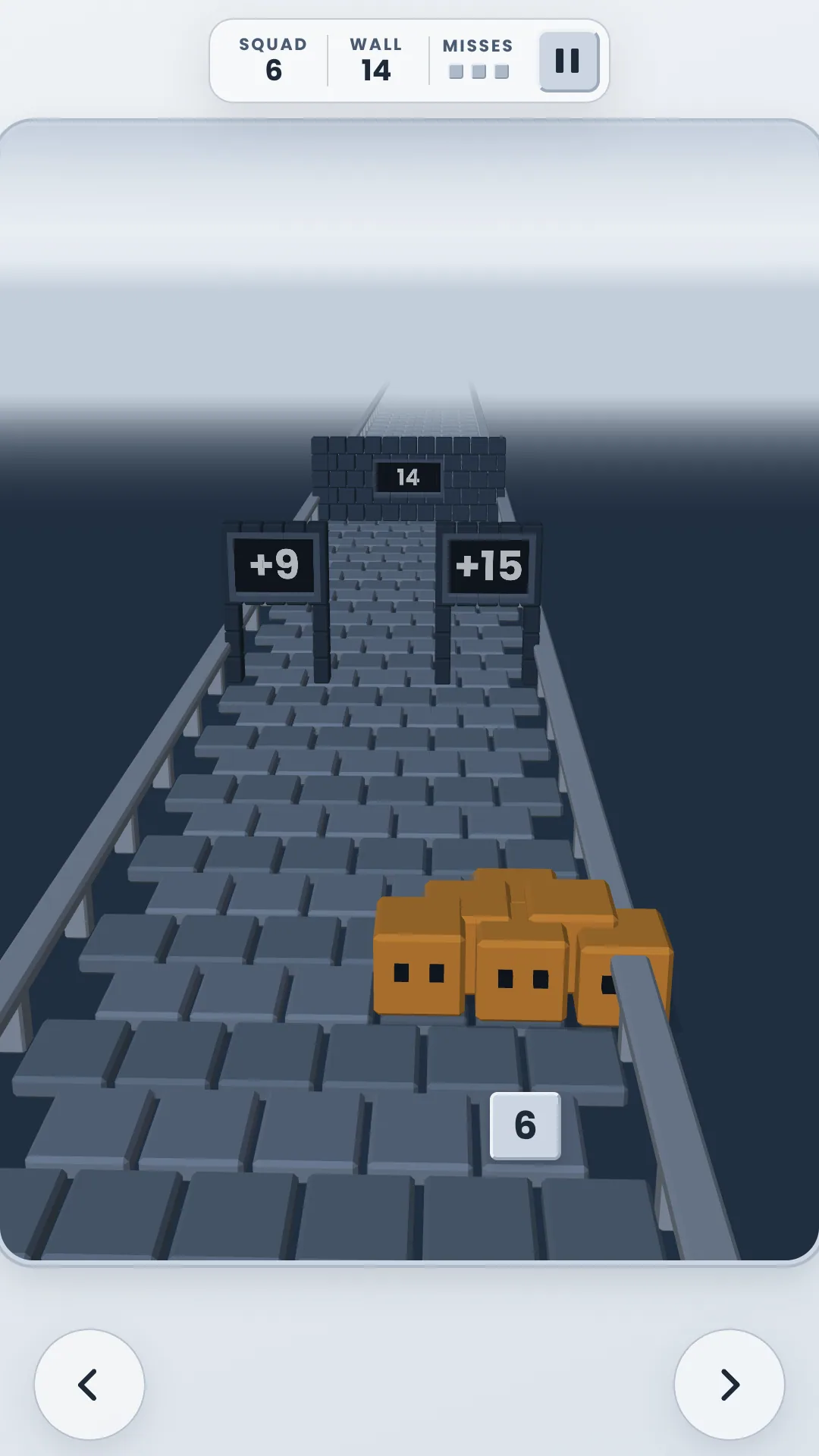
A squad of six amber cubes runs down a three-lane track toward the horizon. Every few seconds a pair of gates crosses the track, each one stamped with an operation drawn from seven: times two, times three, plus nine, plus fifteen, minus four, divided by two, divided by three. You steer into one of them and your squad instantly becomes that number, cubes popping in or puffing out. Behind the gates a wall drops with a number on it. Arrive with at least that many cubes and you smash through and keep the surplus; arrive short and the wall takes the difference out of you and charges a miss.
The decision is never simply the biggest label. Times two on a squad of three is worse than plus fifteen, and plus fifteen on a squad of ninety is barely worth crossing the lane for. What the gate does depends entirely on the number you are carrying, which is the whole point of the game.
When a pair of gates appears, one lane is left empty, and walking through it unchanged is a legal answer. Trios fill all three lanes, and a set of gates that can only shrink you is always a trio, because with an empty lane available a shrink gate could never be the right choice. Making all three lanes cost something turns it into a real question about which loss hurts least.
Ten walls smashed wins the run. Three misses ends it. The track speeds up with every wall cleared and reaches its top pace at the sixth, so most of a successful run is played at full speed.
What is different about this version
The wall is generated after the gates, never before. Once a pair or trio has been chosen, the game collects every number you could be carrying when you reach the wall — each gate's result, plus your current squad if a lane is empty — and clamps the wall between one more than the worst of them and the best of them. That means the wall is always reachable through at least one gate and never reachable through all of them, so there is a correct answer and a wrong one every single time. The gate sets themselves are filtered as well: the results must all be distinct, they must differ by at least two, and the biggest result is scored up when it comes from an addition rather than a multiplication, so the largest number on screen is regularly not behind the times gate. The opening pair is placed in the outer two lanes so your first decision is taken from a standing start rather than from inside a gate.
How to play Number Gates
- Steer with A and D, the arrow keys, or by dragging across the track; your squad starts at six cubes.
- Read both gates before you commit. The operation applies to your current squad size, not to a fixed amount.
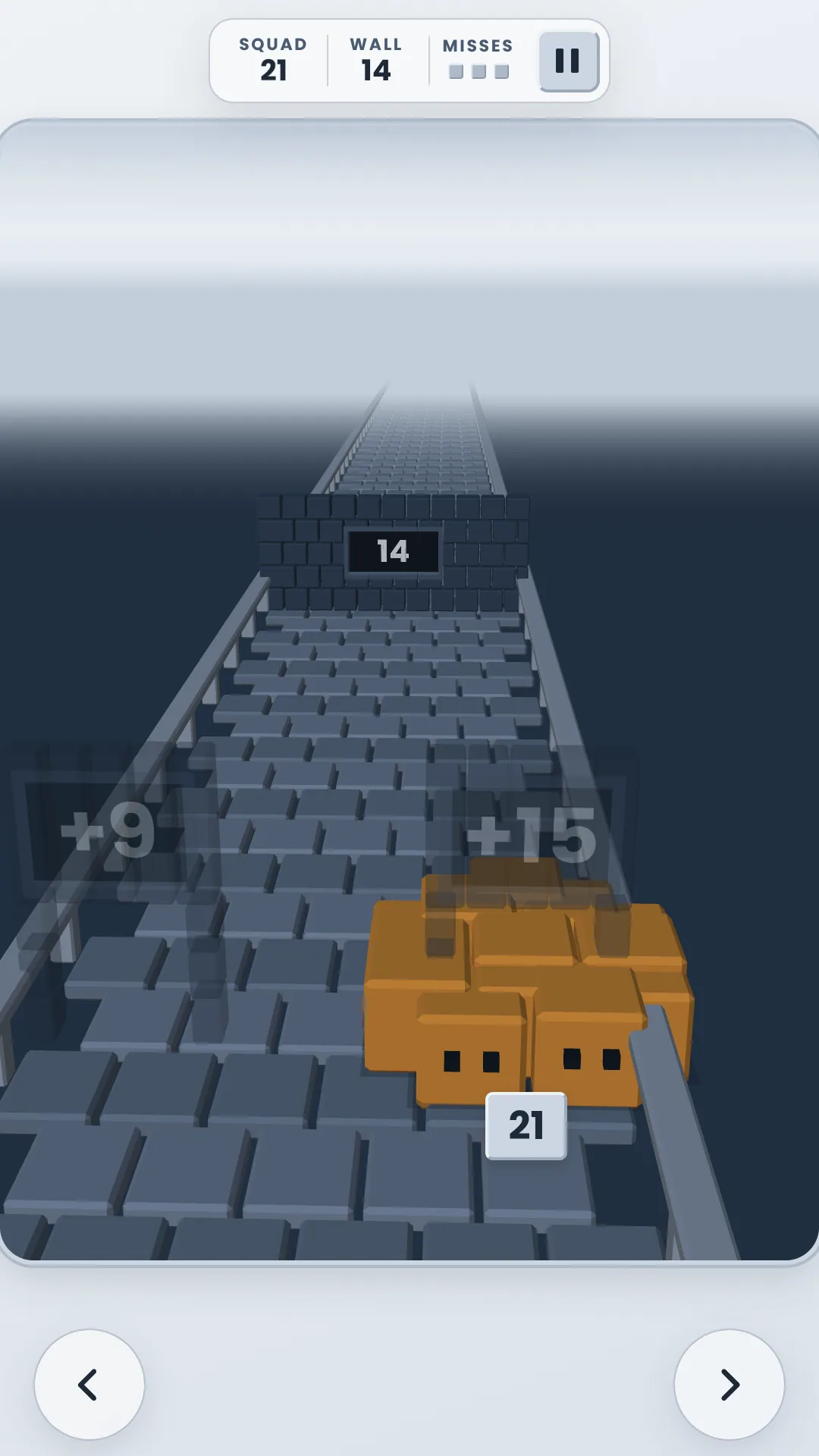
- Running through a gate changes the squad instantly. Taking the empty lane on a pair leaves it unchanged.
- The wall behind each gate shows the number you need. Reach it and you smash through, keeping the cubes left over.
- Arriving short costs a miss and the squad drops by the amount you were short.
- Smash ten walls to win. Three misses ends the run.
Controls
| Desktop | A and D or the left and right arrow keys change lane; you can also drag left and right anywhere on the track. Escape or P pauses, and Space replays from the end sheet. |
|---|---|
| Phone or tablet | Drag a finger across the play area to slide between lanes, or use the two arrow pads in the bottom corners. |
| Players | One player. Any other characters on screen are run by the game. |
Strategy
Work out the wall first and the gates second. The number on the wall is already clamped into the range your gates can produce, so the question is only ever which gate clears it with the least waste, and waste matters because smashing a wall subtracts its number from your squad. A squad of sixty that takes a times three gate for a wall of ninety comes out the far side with ninety cubes, while the same squad through plus fifteen comes out with a miss. Early on, when you are carrying six or eight cubes, the addition gates are worth more than the multipliers and the halving gates cost almost nothing; past about thirty the relationship reverses and a division can be the right answer if the wall is low and a multiplier is waiting behind it. When the set is all shrink gates, take the smallest loss you can still clear the wall with, and remember you only need to equal the wall, not beat it.
Mistakes that cost you the game
- Reading the gate labels as fixed values. Times two is the strongest gate on a big squad and the weakest on a small one.
- Taking the biggest result available without checking the wall number. The surplus is deducted at the wall, so overshooting by fifty wastes fifty cubes.
- Ignoring the empty lane on a pair. Running through unchanged is sometimes better than either gate.
- Switching lanes late. The lane change eases over about a fifth of a second and the gate is applied at your front row.
- Panicking at a trio of shrink gates. One of them still leaves you able to clear the wall.
Tips
- Glance at the wall number before you look at the gates; it narrows the choice to one.
- On a small squad, prefer plus fifteen over times two; on a large one, the reverse.
- A halving gate before a multiplier can beat an addition, because the multiplier compounds what you keep.
- Commit to a lane early and let the eased steering settle before the gate reaches you.
- Speed stops rising at the sixth wall, so the last four walls are no faster than the sixth.
Questions about Number Gates
What happens when I reach a wall short?
You lose the difference. A squad of twenty against a wall of thirty leaves ten cubes, and it costs one of your three misses. The wall stays where it is and the run continues.
Can a wall be impossible?
No. The wall is built after the gates and clamped so at least one gate always reaches it. If you miss, the gate you needed was on screen.
Is there a timer or anything that drains?
No. Misses are the only way to lose and every miss is a wall you arrived at short, which you watched happen.
Are there difficulty settings?
No. The track speed rises from the first wall to the sixth and stays there, and that ramp is the whole difficulty curve.
Does it cost anything?
No. Number Gates is free to play, runs in your browser, and needs no download, install or account.
More games like this
-
 Claw CraneA candy-pink claw machine full of plush critters, and ten tokens to win them all
-
 Dodge Circle 3DOne ring, throwers all round the rim, and a dash with just enough invincibility to matter
-
 Drift CarA hundred seconds in a walled arena while beach balls the size of the car come at you
-
 Fold LabFold nets into cubes and punch folded paper, all in your head