
Air Hockey
A puck that sheds almost no speed, and nowhere on the table to hide
About Air Hockey
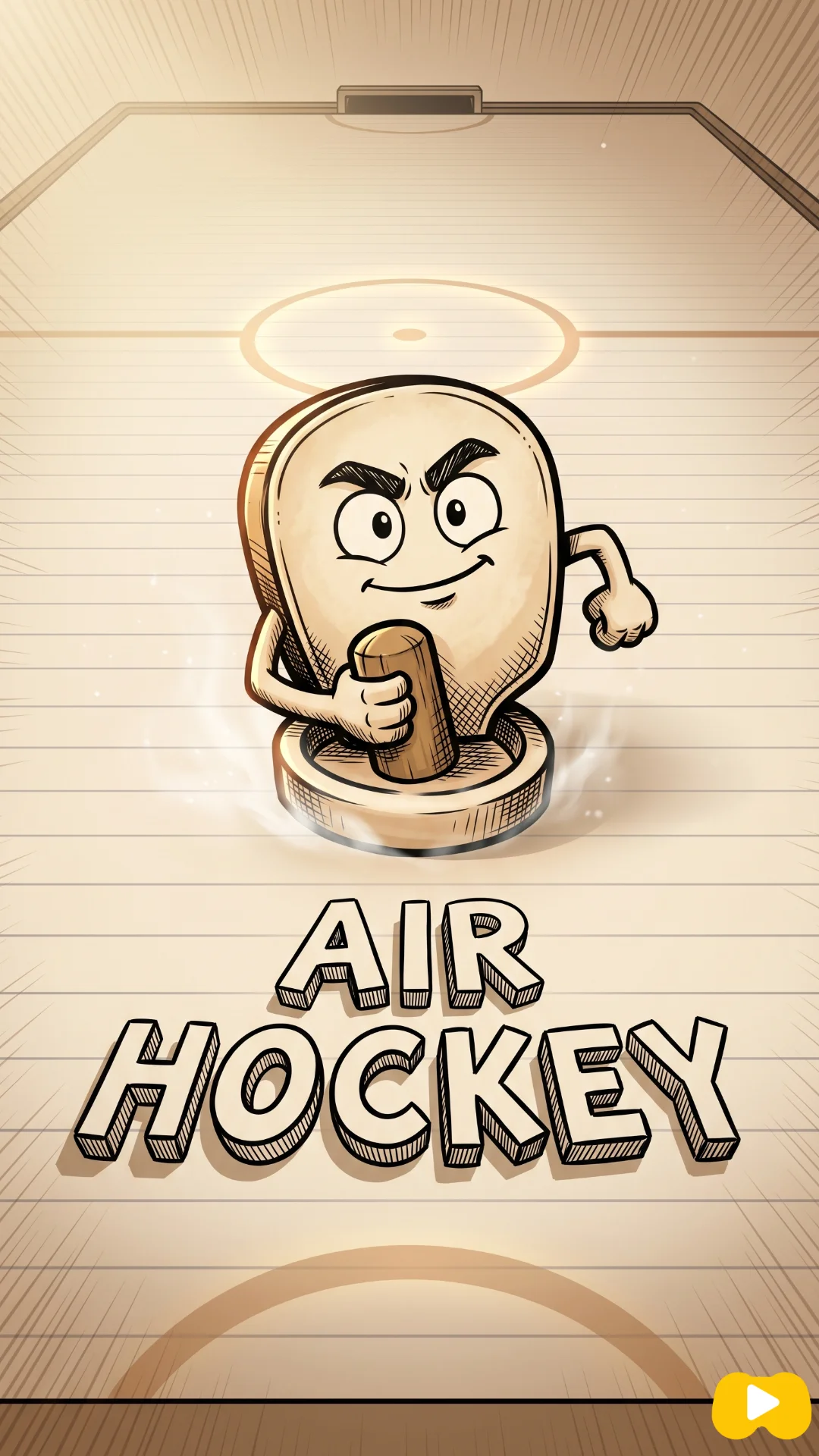
The table is drawn in soft doodle lines and the physics underneath is not soft at all. The puck keeps roughly ninety-eight and a half per cent of its speed every frame, which on a real table would be a sheet of glass, so a rally that starts fast stays fast until somebody mishits it. There is a hard ceiling on how quickly it can travel, but a firm strike can push it half again past that ceiling for a moment before the cap pulls it back — which is exactly the shot that beats a goalkeeper.
You can play it alone against a computer mallet at three settings, or hand the other half of the table to whoever is next to you. Either way it is first to five, and a goal hands the puck straight back to the side that conceded, so a two-nil lead never turns into a procession.
What is different about this version
Two things. The mallet does not teleport to your finger — it chases the target with a heavy smoothing filter, so it carries real momentum, and how hard the puck leaves depends on how fast the mallet was already travelling when it arrived. A stationary mallet absorbs a shot. That is a deliberate choice, and it is why flicking beats shoving. The second is an anti-camping rule. Park the puck in the computer's half and hold it still for two and a half seconds, and the AI backs off entirely while the puck is nudged back toward the middle at a fixed pace. Stalling a lead is not a strategy the game will let you use. Goals also drop into slow motion for a fraction of a second, which is long enough to see what went wrong.
How to play Air Hockey
- Choose the computer opponent or the shared table from the pause sheet, and set its level if you are playing alone.
- Guard the goal at your end and hit the puck into the one at the far end. The goal mouth is a little under a quarter of the width of the board.
- Walls have no give, so a bank shot off the side rail counts the same as a straight one.
- First to five wins. After every goal the puck is served to whoever was just scored on.
Controls
| Desktop | Player 1 uses WASD; the second player uses the arrow keys. Against the computer you can use either set. |
|---|---|
| Phone or tablet | Drag anywhere in the bottom half to move your mallet; a second finger in the top half controls the other player. |
| Players | One or two people on the same device. Nothing here plays over the internet. |
Strategy
Position beats reaction on this table. The mallet is deliberately heavy, so the distance you can cover while a fast puck crosses the board is smaller than it looks — which means it should already be roughly where the puck is going before you decide to move. Sit slightly in front of your goal line rather than on it, and let the rail narrow the angles for you.
Striking is the part most people get wrong. Because the puck inherits the mallet's velocity, waiting with a still mallet produces a limp return that comes straight back. Start moving forward before contact, even a short push, and the same interception becomes a threat. That difference accounts for most of the goal difference in a close game.
The computer's weaknesses are specific. On Easy it aims at where the puck is rather than where it will be, so a puck crossing the table at an angle leaves it permanently behind the play, and bank shots off the side rails beat it almost every time. Normal corrects for most of the lead but still turns slowly, so a change of direction in your own half catches it drifting. Hard leads the puck exactly and sits closer to it when attacking; against that setting the way through is pace rather than angle, since a hard flat strike briefly exceeds the normal speed cap and that burst outruns its repositioning.
Mistakes that cost you the game
- Chasing the puck up the table. The computer serves and counters quickly, and an empty goal at your end is an open goal.
- Meeting the puck with a stationary mallet. It absorbs the pace and gives the puck straight back with nothing on it.
- Trying to hold possession in the far half to protect a lead. After two and a half seconds the puck is pushed back out and the opponent gets a free run at it.
Tips
- Aim a third of the way along the side rail rather than at the goal. The rebound arrives at an angle the defender has not set for.
- Cut the angle by standing off your goal line, not on it. Defending from the line means covering the whole mouth.
- After you concede, the puck is yours — take the restart seriously instead of drifting back.
- On a phone, park your thumb near the middle of your half so every direction is a short move away.
- Watch the slow-motion goal instead of reaching for restart. It usually shows a rail you did not account for.
Questions about Air Hockey
Can I play on my own against the computer?
Yes, and that is the default. The mallet opposite comes at Easy, Normal or Hard; the shared table is the other option.
What separates the three computer settings?
Mallet speed, how far ahead it aims, and how quickly it changes direction. Easy barely leads the puck; Hard leads it exactly.
How many goals win the game?
Five, and a goal drops briefly into slow motion before the restart.
Does the puck slow down between hits?
Barely. It sheds a tiny fraction each frame, so a hard shot is still travelling when it comes back.
Does it cost anything?
No. Air Hockey is free to play, runs in your browser, and needs no download, install or account.
More games like this
-
 FoosballThree rods a side, one shared slider, and forty seconds on the clock
-
 VolleyballBeach volleyball from behind your own eyes, where reading depth is most of the game
-
 5 vs 10Draughts fought with gold five-coins against teal ten-coins, every capture forced
-
 Pool RummyPot the balls, add up their numbers, land on exactly 100