
Tic Tac Push
A 5x5 board, two walkers, loose blocks — shove three of your mark into a line
About Tic Tac Push
Despite the name, this sits closer to a block-pushing puzzle than to noughts and crosses. You control a single coral walker on a five-by-five board scattered with X and O blocks. Each turn you step one square, and if a block is in the way you shove it one square ahead of you — one block only, never off the board, never into another block or a walker.
Three X blocks in a line wins, and so does two X blocks plus your own walker, because the walker counts as its own mark. The blue walker is doing the same with O, and either side may push any block. The rule that catches everyone out is that lining up three of your opponent's mark hands them the win, so a push that solves your problem can end the game in their favour.
Games are short — fifty moves in all — and the opening is drawn from ninety pre-checked layouts, so the first turns are never a memorised script.
What is different about this version
The walker counting as a mark reshapes everything. You carry a third of every line around with you, and standing on the empty end of an opponent's two-in-a-row physically blocks it for as long as you are there. It also creates the only way to lose by your own hand: because the square you step onto reads as your mark, you can never complete an O line by walking, only by pushing an O block into place. The ninety opening layouts are the other deliberate choice — each was checked to have no forced win for either side inside eleven moves, so no colour starts with a trick. Three search depths are offered, from a one-move look-ahead with heavy randomness up to a ten-move search.
How to play Tic Tac Push
- Move your walker one square up, down, left or right each turn.
- Stepping into a block pushes it one square the same way.
- A block cannot be pushed off the board, into another block, or into a walker.
- Three X's in a row, column or diagonal wins.
- Your walker counts as an X, so two blocks plus your body is a winning line.
- If your move completes three O's, the computer wins instead.
- The counter marked Left shows the moves remaining before a draw.
Controls
| Desktop | Arrow keys or WASD to step; you can also click an adjacent square, or drag your walker in a direction. |
|---|---|
| Phone or tablet | Tap the square you want to step into, or drag your walker the way you want to go. |
| Players | One or two people on the same device. Nothing here plays over the internet. |
Strategy
Start by counting what your walker is worth. Any line holding two X blocks and one empty square is a win the moment you can stand in that square, which makes walking threats far cheaper to build than pushing ones. The computer's evaluation knows this — it scores a two-in-a-row by how close its own walker is to the gap — so a threat it cannot reach is a threat it will ignore, and building far from the blue walker buys you a turn or two.
Defence runs the same way in reverse. You cannot lose by stepping, only by pushing, so on a crowded board the safe move is almost always the one that walks into empty space. Before any push, check what the block lands next to: an O block arriving beside two other O's ends the game at once, and the deepest setting will arrange that trap several moves ahead.
Edges matter more than they look. A block flat against a wall cannot be pushed further that way, so the perimeter is where you park pieces you would rather nobody moved, and corners are the strongest version of that. Against the ten-move search the realistic plan is a double threat — two lines that each need one step from your walker, pointing in different directions — because it can only interfere with one of them per turn.
Mistakes that cost you the game
- Pushing because a push is legal. It rearranges the board for both colours and it is the only move that can lose outright.
- Building a threat beside the blue walker. Threats near its own walker are the ones it answers first.
- Hunting for three loose blocks when two plus a step from your walker would have done it.
- Blocking an O gap and then wandering off. The square goes live again the moment you leave.
- Ignoring the move counter. A slow grind becomes a draw at fifty whoever is ahead.
Tips
- Push blocks toward walls. Against an edge a block cannot move that way again, which makes your lines harder to dismantle.
- Set up two one-step threats at once; a single search can only answer one per turn.
- Learn the pushing rules on Easy, then go straight to Hard — the middle setting mostly changes how far ahead it looks.
Questions about Tic Tac Push
Is this normal tic tac toe?
No. There are no cells to claim — you walk a piece around a five-by-five board and shove blocks into position, and the walker counts as a mark.
Can I lose on my own move?
Yes, by pushing an O block into a line of three. Stepping never does it, because the square you stand on reads as your own mark.
Is there a two-player mode?
Yes — two people take turns on one device, a walker each.
What happens when the counter runs out?
It is a draw at fifty moves, and also a draw if neither walker has a legal move left.
Does it cost anything?
No. Tic Tac Push is free to play, runs in your browser, and needs no download, install or account.
More games like this
-
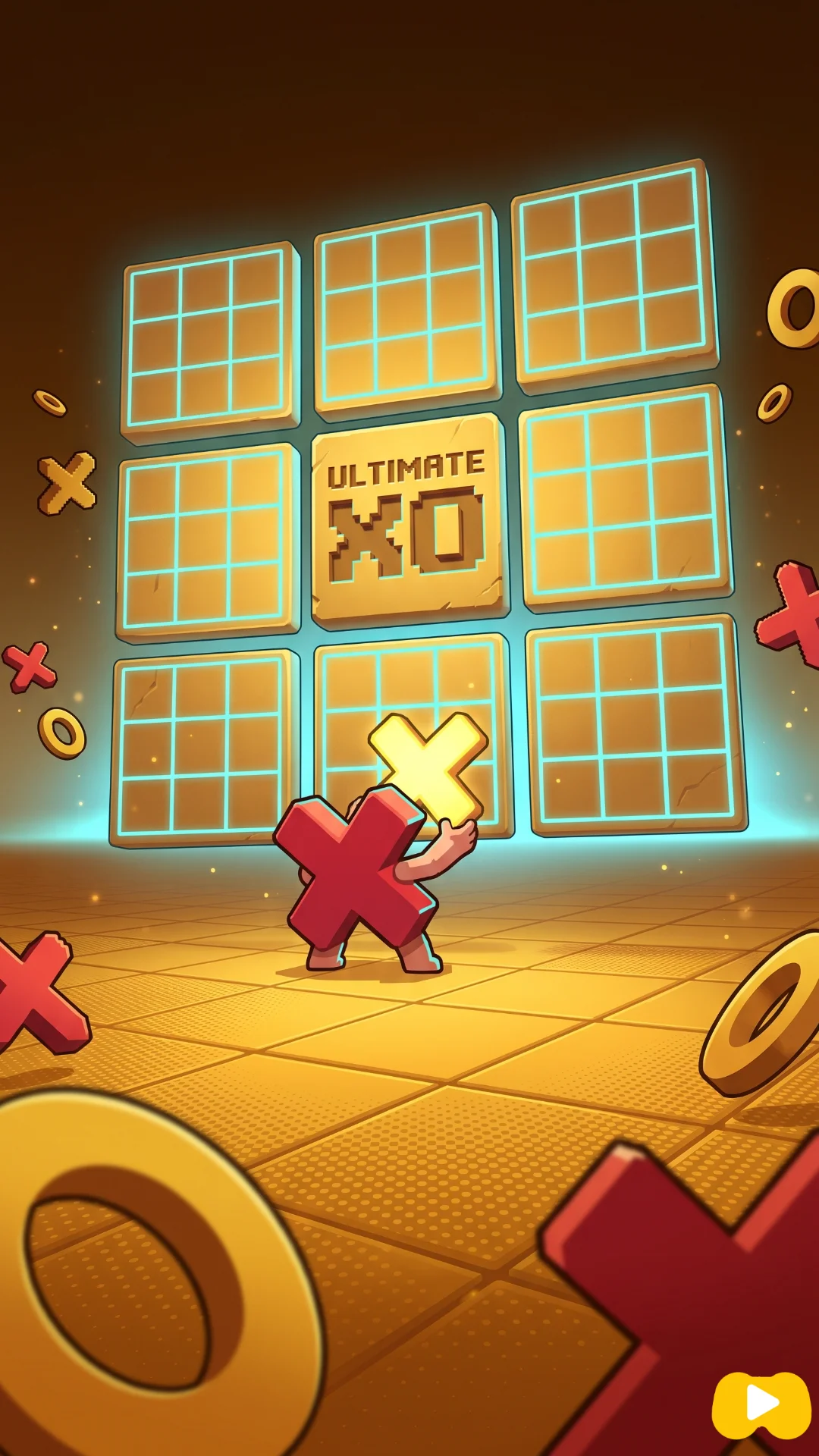 Bigger Tic Tac ToeNine small boards inside one big one, and your square picks where your opponent plays
-
 ChessEvery rule of chess, and an opponent that never looks at your reply
-
 Four in LineSeven columns, six rows, and a search that would rather block you than build
-
 Ant ColonyEight ants underground, sixteen duties to finish, and one of them is not an ant