
Sumo Fighter
Mash to build power, lean into the lock, shove them over the rope

About Sumo Fighter
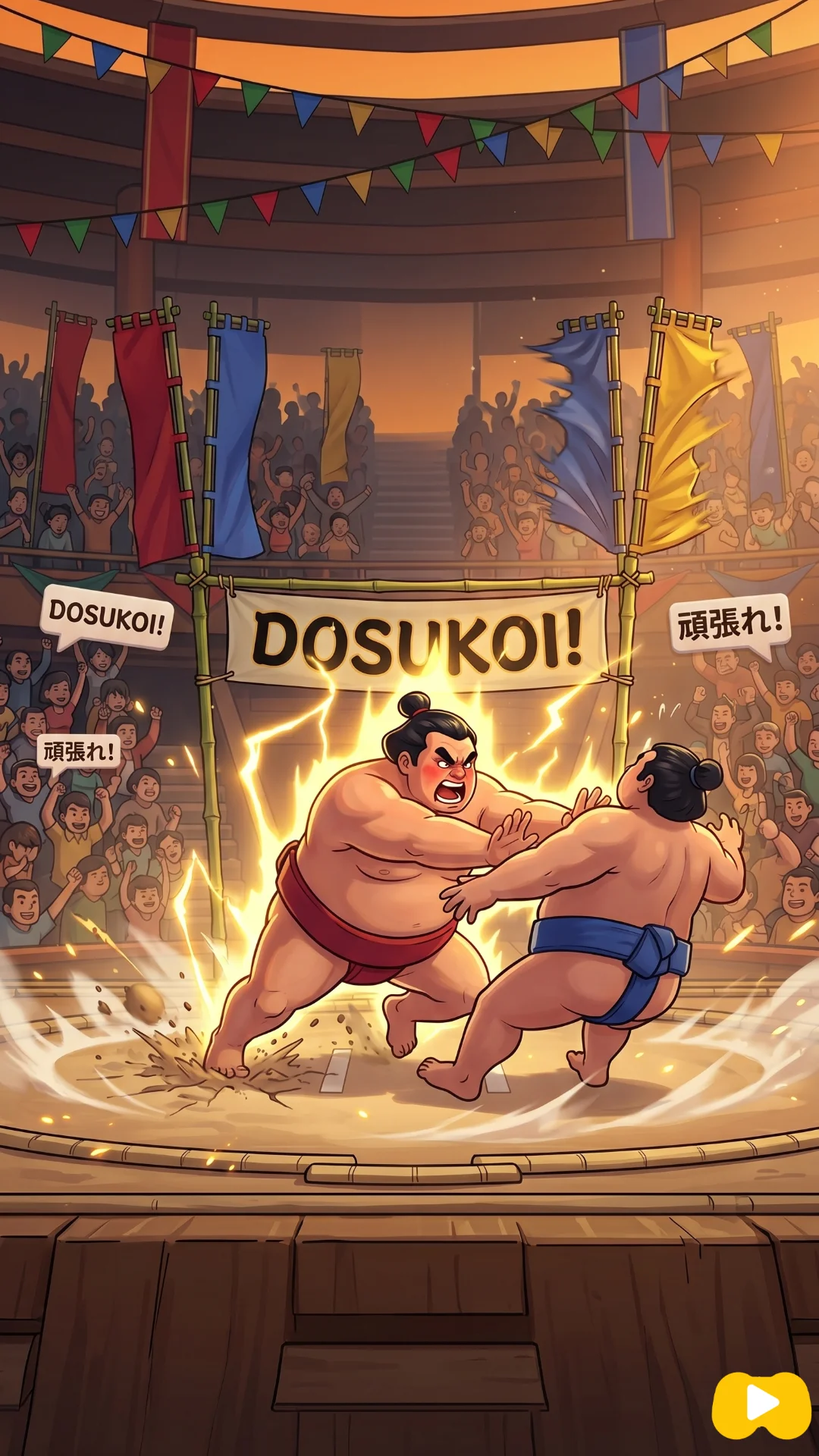
Two wrestlers, a round dohyo drawn in three-quarter view, and a rope you are trying to put the other one across. You move freely on the clay — this is not a tug of war on rails — and you build shoving power by hammering a single button. Stop hammering and it bleeds away within a second or two.
The interesting part is the moment the two bodies touch. You lock, and your input splits in two: pushing along the line between you drives them backwards, pushing across it tries to slip around them. Whoever has more power banked when the lock forms usually wins the exchange, though footing wanders randomly by about a seventh either way. First to two rounds takes the match, and a round is normally over inside twenty seconds.
What is different about this version
The original this is rebuilt from was a pure masher: the pair began locked together and the stronger charge decided it. Here you have to find your opponent first, on a circle you can walk anywhere on, so aim is as much of the problem as power and a charge thrown at where somebody used to be is simply wasted. Two quieter rules do most of the balancing. Footing drifts — a grip factor wanders up to fourteen per cent either side of normal every half second, so identical inputs give slightly different outcomes. And legs weaken the nearer you are to the rope, by as much as forty-two per cent right on the edge. That second rule exists to break stalemates, and it makes losing ground a compounding problem rather than a recoverable one.
How to play Sumo Fighter
- Pick vs CPU at easy, normal or hard, or 2 Players for the person beside you.
- Walk your wrestler around the clay circle.
- Hammer the push control. Each tap adds power; releasing drains it.
- Make contact. Once locked, push along the line between you to drive, or across it to slip around.
- At full power a surge fires by itself — a heavy shove that all but cancels their sidestep.
- Put the other wrestler past the rope. Two rounds wins the match.
Controls
| Desktop | Player one uses WASD with F to push; player two uses the arrow keys with L. |
|---|---|
| Phone or tablet | Stick on the left, Push on the right. In two-player the touch pair belongs to player one and the second player needs the arrows and L. |
| Players | Two people, but both need a keyboard — the second set of controls has no touch equivalent, so this is a laptop game rather than a phone game. |

Strategy
Power decays, so when you mash matters more than how much you mash. Banked power falls at around one and a half times its own value every second, which means hammering from across the ring leaves you arriving with almost nothing. Close most of the distance on the stick alone and mash in the last half second before contact. While you are still apart each tap also produces a small lunge forward, so the final stride is free if you take it with taps rather than with walking.
The edge rule shapes the rest. Your push is scaled down in proportion to how far you are from the centre, so being driven back two metres costs you more than it looks like it should, and the middle of the circle is the thing you are really fighting over. When you are the one being driven, do not push straight back — push sideways. Slipping around a lock costs nothing and leaves an opponent who was leaning hard into you standing next to the rope you just came off. The exception is a surge: while one is landing, your sideways movement is cut to a quarter, and the only counter is to have banked enough power of your own to meet it.
Mistakes that cost you the game
- Mashing from the far side of the ring. Power drains as fast as you build it, so you arrive empty.
- Charging a hard computer head-on. It reads incoming speed and sidesteps over half the time.
- Pushing straight back when you are already on the rope. Your legs are weakest exactly there; theirs are not.
- Never using the sideways input. Slipping around a lock is usually better than winning one.
Tips
- Five taps takes you from empty to full, so short bursts work better than constant hammering.
- Watch for the surge. It fires on its own the moment you top out, so be facing the right way.
- Let a missed charge go past, then turn. Their own momentum carries them towards the rope.
- The computer reads the rope well on hard and badly on easy.
- Two rounds is the whole match, so the first one is worth more than it feels at the time.
Questions about Sumo Fighter
Is this two people on one device?
Yes, on a keyboard: WASD and F against the arrows and L. There is no online play.
Does tapping faster always win?
Not by itself. Power caps out, footing varies, and position near the rope weakens your push. Someone with less power in the centre often beats someone with more on the edge.
How quickly is a match over?
First to two rounds, and rounds rarely run past twenty seconds.
What do easy, normal and hard actually alter?
How quickly the computer reacts, how fast it mashes, how carefully it tracks the rope, and how often it sidesteps — one charge in ten on easy, more than half on hard.
Does it cost anything?
No. Sumo Fighter is free to play, runs in your browser, and needs no download, install or account.
More games like this
-
 5 vs 10Draughts fought with gold five-coins against teal ten-coins, every capture forced
-
 Air HockeyA puck that sheds almost no speed, and nowhere on the table to hide
-
 Ant ColonyEight ants underground, sixteen duties to finish, and one of them is not an ant
-
 Boat TaggerNinety seconds of paper boats chasing each other round a garden pond