
Potato Pong
Pong with a goal mouth in each end wall and a lumpy potato instead of a ball
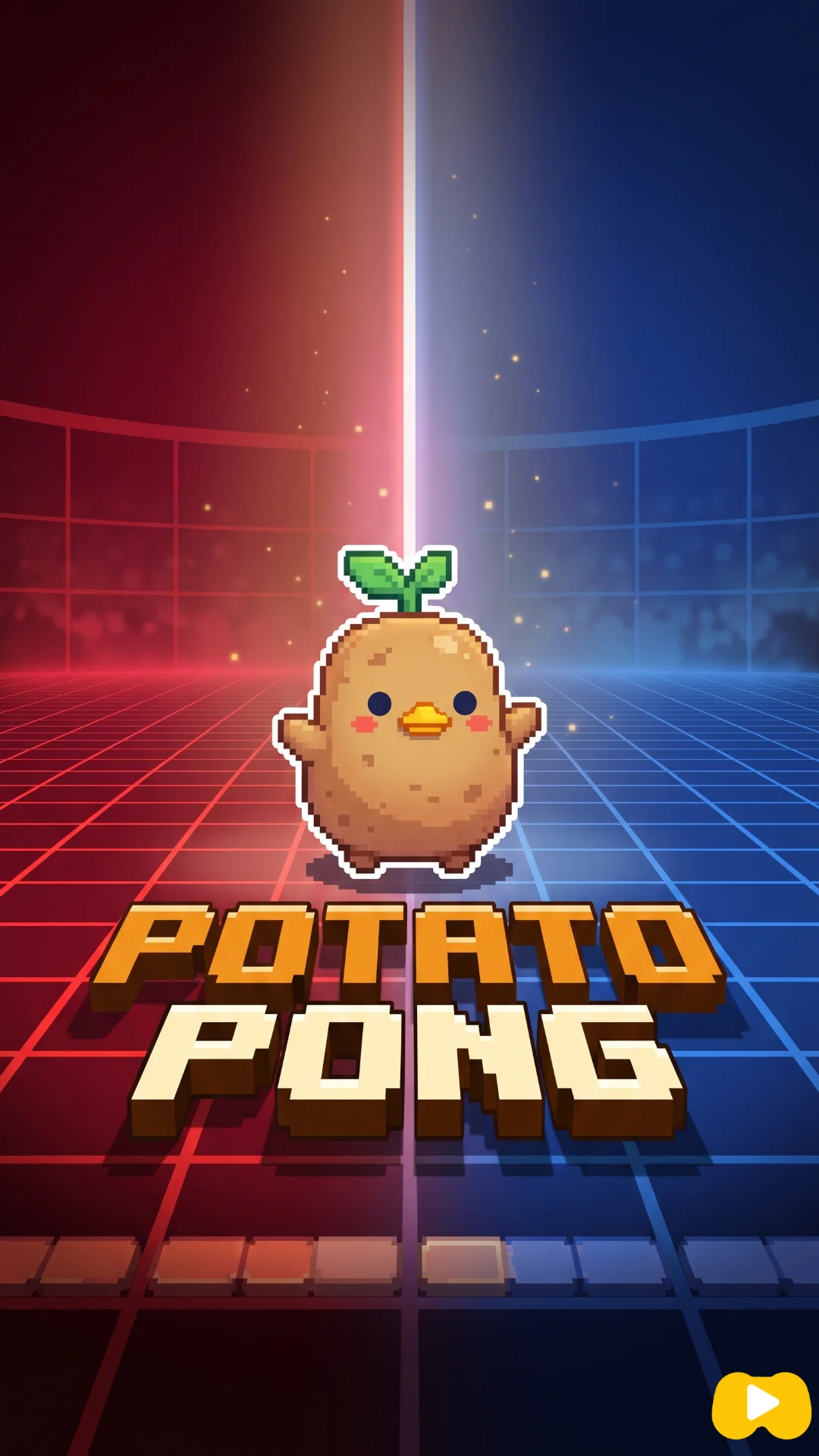
About Potato Pong
Potato Pong keeps the two paddles and throws out the wall. Each end has a goal mouth roughly six tenths of its width; anything you send at the solid strips on either side of it simply bounces back into play. Scoring therefore means aiming rather than merely returning, and the first player to five goals takes the match.
The ball is a potato: a lumpy, hand-drawn outline that squashes along the direction it was hit and sheds crumbs off the walls. It picks up seven per cent more speed with every paddle contact, from a gentle nine up to a hard cap of eighteen, so a rally twenty strokes deep is a different game from the one that started it.
The court reorients itself to your screen. Held upright it runs top to bottom with you at the bottom; turned sideways it rotates so you are on the left, which means two people can sit opposite each other over a phone or side by side over a laptop without either of them playing upside down.
What is different about this version
The Easy CPU has a specific blind spot that is worth knowing about. Normal and Hard project where the potato will arrive including its bounces off the side walls; Easy projects the straight line and clamps it to the court, so a ball that banks off a wall on its way over lands somewhere the Easy paddle was never going. That single difference is worth more than its slower paddle. The other deliberate choice is that the paddles cannot trap the potato. A hit on the side or the back of a paddle knocks it out sideways instead of wedging it against the end wall, which keeps rallies moving rather than ending in a scrappy grind in the corner.
How to play Potato Pong
- Serve, then slide your paddle across your end to keep the potato out of your goal.
- Return it with the edge of the paddle to angle it, or the middle to send it straight back.
- Put it through the mouth in your opponent's end wall to score; the strips either side of the mouth just rebound.
- Five goals wins, and the ball resets to the centre after each one.
Controls
| Desktop | Drag with the mouse for fine control, or use WASD; in two-player, Player 1 has WASD and Player 2 has the arrow keys. Esc or P pauses. |
|---|---|
| Phone or tablet | Slide a finger anywhere on your half of the court; in two-player each person controls the half nearest them. |
| Players | One or two people on the same device. Nothing here plays over the internet. |
Strategy
Angle comes from contact offset. The potato leaves the paddle at up to sixty degrees from straight, set by how far from the paddle's centre it struck, and about twelve per cent of your paddle's own sideways speed is added on top. Hitting while moving is therefore a genuine shot rather than a save, and it is the only way to steer the ball away from a CPU that is already tracking the straight-line return.
The goal is central, so your default position is central. Wide shots are only worth playing if they are wide enough to miss the mouth entirely, and those are the ones that come back off the solid strips at an angle you chose — fire one deliberately and you can catch a paddle that has committed to the wrong side. The same geometry works against you, so watch where your own misses will rebound to before you swing. Speed is the clock. At the serving pace both paddles cover the court comfortably. Past about fourteen, reaction time runs out and position decides everything, so if you are ahead there is nothing wrong with playing soft, central returns that keep the acceleration down. If you are behind, do the reverse and force the pace, because the CPU's aim error is defined to widen as the ball gets quicker — its sloppiest shots are the fast ones.
Mistakes that cost you the game
- Steering with the keyboard when a finger or the mouse is available. Pointer control moves the paddle several times faster, and in a game decided by the last few pixels that gap is the match.
- Parking on the centre line and only reacting. The goal is central, but a paddle that never moves has no shot of its own — all its returns go straight back.
Tips
- Against Easy, bank the potato deliberately off a side wall. It plays the straight line and will not be there.
- Hit with the outer third of the paddle to open the angle, the middle to kill it and slow the rally down.
- Keep the paddle moving through contact rather than stopping on the ball.
- Aim just inside a post rather than dead centre; a centred shot is the one their paddle is already covering.
Questions about Potato Pong
How big is the goal?
About sixty per cent of the end wall, centred. Shots outside it rebound off the solid sections and stay in play.
Does the ball keep getting faster forever?
No. It gains seven per cent per paddle hit and stops at double its serving speed, which is quick but still returnable.
Does the split-screen control work on a small phone?
Yes. Pick 2 Players and each person controls the half of the screen nearest them; portrait puts you at the bottom, landscape puts you on the left.
Does it cost anything?
No. Potato Pong is free to play, runs in your browser, and needs no download, install or account.
More games like this
-
 Smile BallTwo grinning blobs, one bouncy ball, and a rule that punishes goal-hanging
-
 5 vs 10Draughts fought with gold five-coins against teal ten-coins, every capture forced
-
 Air HockeyA puck that sheds almost no speed, and nowhere on the table to hide
-
 Ant ColonyEight ants underground, sixteen duties to finish, and one of them is not an ant