
Hole Eater
Thirty seconds, one city, and a hole that only grows by eating

About Hole Eater
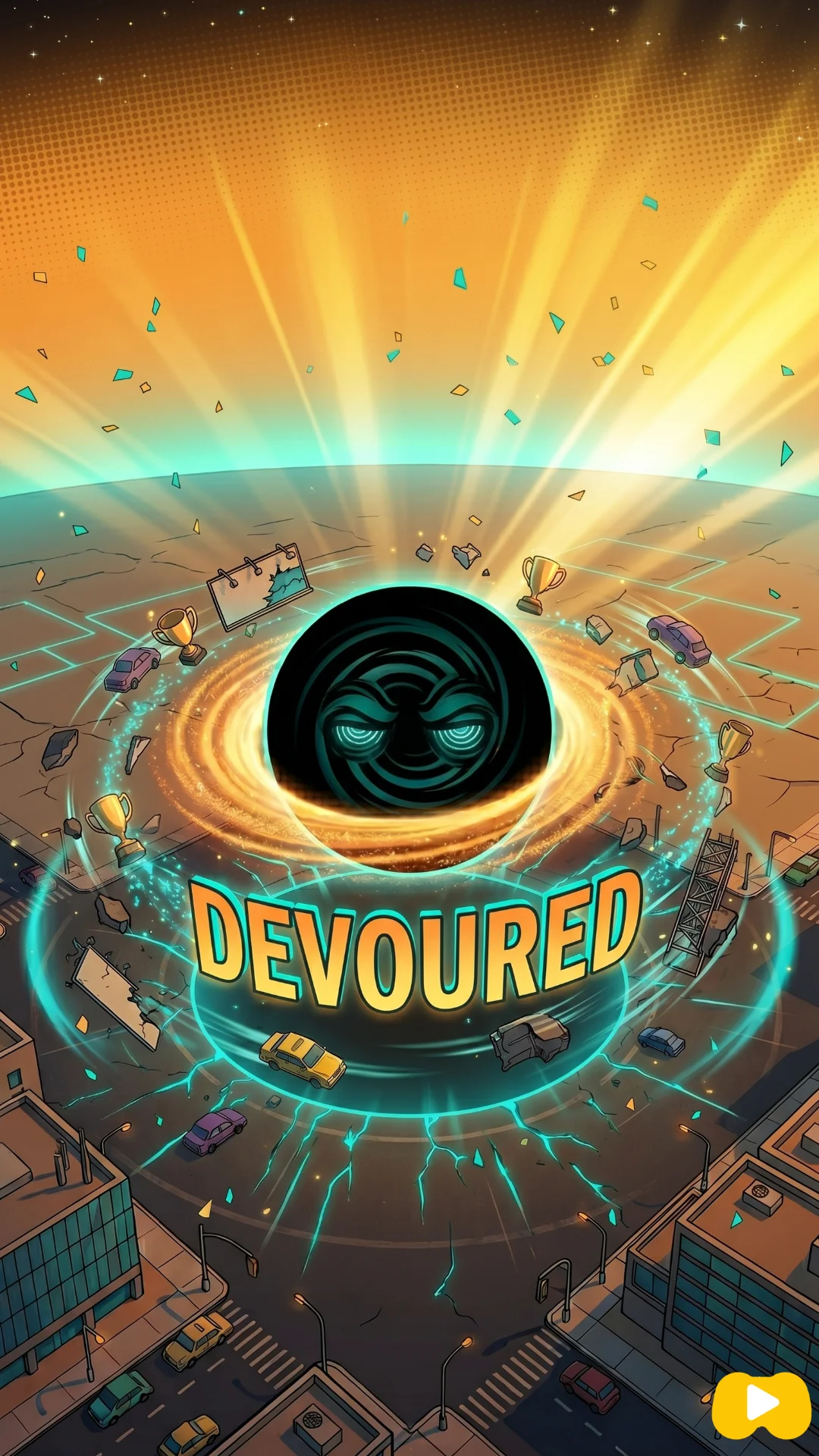
You are a hole in the pavement of a small grid city — twenty-two blocks square, with roads, verges and buildings — and you start thirty seconds on the clock. Anything smaller than about one and a half times your width drops straight through and makes you a fraction wider. Cones and hydrants first, then benches and trees, then cars, then houses, and the scale keeps climbing until a stadium becomes something you can plausibly eat.
There is nobody else on the map. The whole thing is you against the clock, and the clock is the only thing in the game you can negotiate with: alarm clocks scattered around the city add three seconds each, and the first five buildings you swallow add two apiece. After that the return tapers to one second, and after fifteen buildings it stops, so a round always ends inside forty seconds no matter how well it is going.
What is different about this version
Everything that can move, runs. People, dogs, cats, cars and trucks all notice you once you are within five hole-widths of them and break into a panic that is half again as quick as their normal pace, and they steer away from the map edges while they do it, so cornering a pedestrian against a wall does not work the way you expect. Cars also queue behind one another in traffic rather than driving through each other. The other quiet decision is in the growth curve: each swallow adds less than the last, scaled down as you get wider, so eating a hundred traffic cones will never make you big enough for a skyscraper. You have to climb the size ladder rung by rung, and the small stuff stops paying almost immediately.
How to play Hole Eater
- Steer the hole around the streets. There is no accelerator — you move at a fixed speed that only rises slightly as you grow.
- Swallow anything smaller than roughly one and a half times your current diameter. Everything else is scenery until you are bigger.
- Chain swallows less than two seconds apart to build a combo. The multiplier climbs by one each link, up to ten.
- Pick up clocks and swallow buildings to buy back time, but the clock will never pass forty seconds.
- The round ends when time runs out. Anything still falling at that moment does not count.
Controls
| Desktop | Steer toward the mouse pointer, or use WASD and the arrow keys. |
|---|---|
| Phone or tablet | Press and drag anywhere to raise a floating thumbstick under your finger. |
| Players | One player. Any other characters on screen are run by the game. |

Strategy
The scoring is multiplicative, so the shape of your route matters more than what is on it. A combo survives roughly a second and a half between swallows, and the multiplier tops out at ten after nine unbroken links. Nine small objects in a row is easy to arrange and worth far more than the same nine taken separately — which means an early lap through a dense strip of cones, benches and hydrants sets up a multiplier that is still running when you reach the first car. Break the chain and you start again from one.
That gives the round a clear shape. The first ten seconds are about growth rather than points: swallow the cheapest, densest cluster you can find to get through the early size thresholds fast, because the tier you can eat determines everything after. Once houses are available, the arithmetic changes completely — two hundred points against a bench's twelve — and from there you should ignore small objects entirely except as combo filler between buildings.
Moving targets are worth chasing only while you are small. A cat is worth twice a bench, but it runs at nearly twice a person's speed, and time spent pursuing it is time not spent on the row of parked cars behind you. Trucks are the exception: a hundred points, slower than everything else, and they sit on the roads where you are travelling anyway. Late on, the correct move is to stop steering for individual objects and start steering for whole blocks, letting the buildings and everything around them go down together while the timer ticks back up.
Mistakes that cost you the game
- Hunting a single large building before you can actually take it. Nothing happens on contact, and the seconds are gone.
- Letting the combo lapse between big meals. Two buildings taken four seconds apart score far less than the same two with a lamppost in between.
- Grabbing clocks while the timer is near its ceiling. Anything over forty seconds is discarded.
- Staying on the roads for the whole round. Vehicles are there, but the interiors of the blocks hold the dense clusters that build combos.
Tips
- Take the first cluster you see rather than the best one. Early size is worth more than early points.
- Follow a road rather than crossing it — cars travel in lanes and queue, so a road is a moving conveyor of fifty and hundred point targets.
- Watch the size readout rather than the hole itself. The camera pulls back as you grow, so you look the same size while the numbers say otherwise.
- Announcements about a new building class becoming available are your cue to change what you are hunting immediately.
Questions about Hole Eater
Is anything else competing for the city?
No. It is a solo run against the timer — nothing on the map is trying to eat you.
How does the timer get extended?
Clocks give three seconds, the first five buildings two each, buildings six to fifteen one each, and nothing after that. Forty seconds is the hard ceiling.
Why did a building I reached not fall in?
You have to be roughly two thirds of its size before it counts as edible. Until then it simply sits there.
Does it cost anything?
No. Hole Eater is free to play, runs in your browser, and needs no download, install or account.
More games like this
-
 Ball EaterSwallow anything eight per cent smaller, and stay well clear of the spiky red one
-
 Balling BallSlide the floors under a bouncing ball and drop it through the gaps
-
 Claw CraneA candy-pink claw machine full of plush critters, and ten tokens to win them all
-
 DodgeballOne against the pack, three lives, and a catch that knocks the thrower straight out